We were taught the French Revolution as the triumph of progress. In July 1789 the Bastille fell, liberty, equality and fraternity were proclaimed, and the old order of estates came to an end. I believed that version for a long time. But in November 1790, while the revolution still looked like a festival and three years before the Terror began, an Irish-born member of the British Parliament published a book. Edmund Burke’s Reflections on the Revolution in France. He wrote that this revolution would end in bloodshed and military dictatorship, and that is very nearly what happened. The question I want to hold onto today is this: were the revolutionaries actually right? On what was their certainty founded?
Burke Was No Reactionary — Which Is Why His Critique Carries Weight
Let’s clear away a misconception first. Many people file Burke away as a diehard who pined for monarchy, but his record runs nearly the opposite way. On the American colonies, he led criticism of the British government’s coercive taxation and argued for conciliation (though it should be said precisely that he opposed independence itself). In India, he denounced the plunder of the East India Company and Governor-General Warren Hastings, driving the most famous impeachment trial in the empire’s history. In Ireland, he demanded an end to discrimination against Catholics and helped secure the franchise for Irish Catholics in 1793. He spent a lifetime attacking the abuse of power.
There is a reason I raise this record first. Had he been a man who opposed all change, his critique of the French Revolution would be merely an expression of temperament. But he was a man who took the side of change elsewhere. And that same man turned his back on France alone. So what was the difference he saw? That is where this piece begins.

The Problem With Blueprints — Reason Is Smaller Than We Think
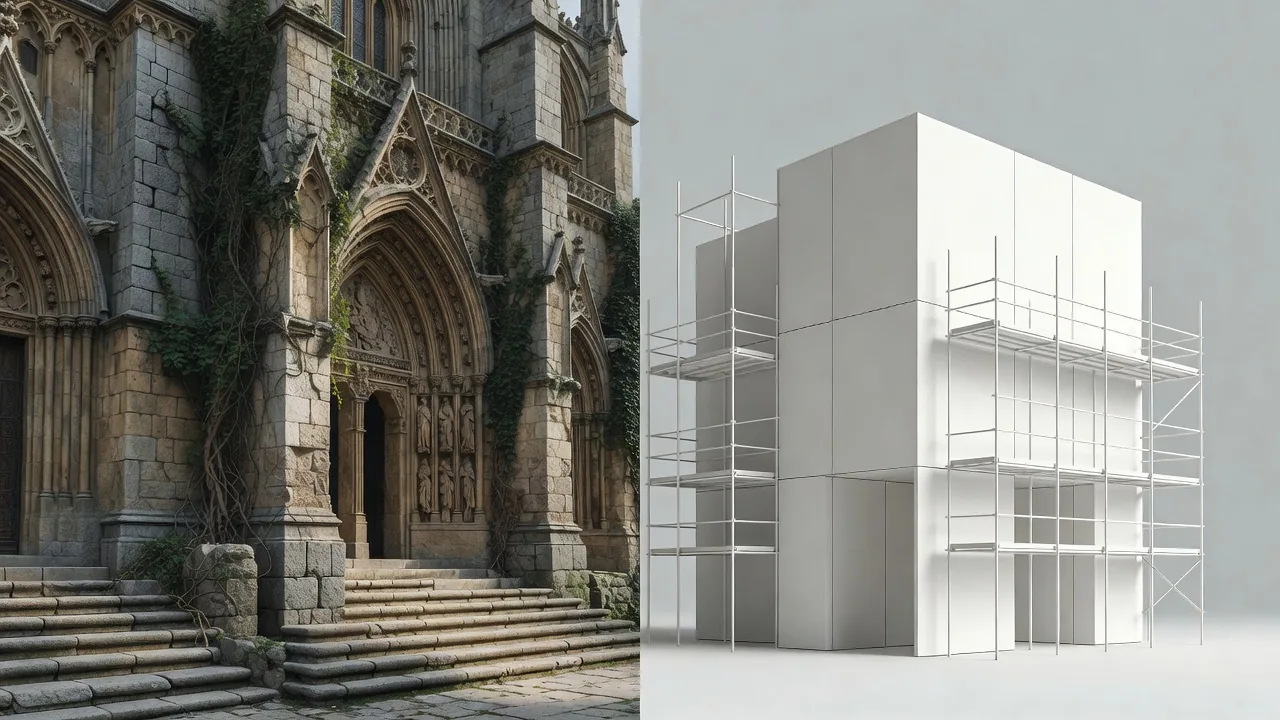
The difference Burke saw was method. The Americans fought saying they were defending the English liberties and customs they already enjoyed. The French revolutionaries, by contrast, proposed to return society to a blank sheet, draw a new blueprint by pure reason, and build again from the foundation. Estates, church, provinces, guilds, customary law — everything accumulated became a demolition target under the names of “superstition” and “privilege.”
Burke’s counterargument is simple but sharp. The reason of a single generation is not that large. That an institution looks irrational to us does not mean centuries of trial and error are absent from why it hardened into that shape. Our failure to read that accumulation may be a limit of our comprehension rather than a defect in the institution. So he saw society as a contract between generations — not a contract among the living only, but a partnership between the dead, the living, and those not yet born. From this vantage, the very notion that the present generation may overturn everything by majority becomes an overreach.
So he did not reject change. On the contrary, in the spirit of his line that a state without the means of some change is without the means of its own conservation, he held that a system incapable of reform eventually collapses. What he demanded was pace and humility. Repair it, but do not raze it; move one step at a time while watching the results.
Here Burke reaches for a word perfectly designed to be misunderstood today: “prejudice.” He did not use it pejoratively. When people judge right from wrong, they do not construct arguments from a blank page each time; they respond immediately from habits and instincts settled over long years — and that accumulated intuition is what he meant. In his view this intuition contains experience compressed but never articulated. It is easy to dismantle by logic, but what remains in its place is often not a better logic — it is an empty space. Revolutionary France did in fact try to redesign the calendar, weights and measures, even religious rites in the name of reason, and little of it survived.
In the same vein he valued prescription — the idea that a practice long maintained accrues a certain legitimacy of its own. This logic is of course dangerous, since it can be used to justify slavery or discrimination on the grounds of age alone. I regard this as a clear limit in Burke’s principle. But what he meant is closer to this than to “everything old is right”: “the fact that you cannot see the reason is not proof that no reason exists.” Read that narrowly, it remains a valid warning today.
Burke’s Real Target — The Certainty That “We Are Right”
Here we reach the core of this piece. As I read him, Burke’s target was not monarchy, not equality, not even revolution itself. What he took aim at was the revolutionaries’ magnitude of certainty. They believed their blueprint was correct almost without doubt. And because they believed it was correct, removing whatever obstructed that blueprint became justified.
But on what was that certainty founded? They were not gods. The men gathered in the salons of Paris and the National Assembly were brilliant, but they were, in the end, flawed human beings. They had biases, ambitions, fears, and factional interests. The knowledge they held about human nature and how societies work was pitifully small next to the complexity of what they meant to overturn. And still they did not size their certainty to fit the size of their evidence. This imbalance is what Burke found terrifying. They were dangerous not because they were wicked, but because they were ordinary people who believed they knew more than they knew.
When certainty outgrows evidence, opposition stops being “a mistaken opinion” and becomes “an obstacle to be removed.” Revolutionary violence usually issues not from malice but from this surplus of certainty.
And What Actually Happened
One thing deserves emphasis: the revolution did not turn to madness overnight. It slid, one step at a time. The National Assembly of 1789 was in fact moderate. It contemplated constitutional monarchy and adopted a declaration of rights. Then the king attempted flight and trust collapsed; neighboring kingdoms mobilized and the whole country fell into a siege mentality. Once war began, every opposition started to look like collusion. And the logic opened that emergencies require emergency measures. Each stage had its own reasons. That is precisely what makes it frightening. No one resolved, “let us now begin a Terror,” and yet reasoned choices piled up until they arrived there.
Three years after Burke’s book appeared, from September 1793 to July 1794, roughly ten months of the Terror swept France. Death estimates vary widely across sources, but official executions are counted at somewhere around 17,000 (of which some 16,000 were by guillotine), and many estimates put total deaths at 30,000 to 50,000 once summary executions without trial and deaths in prison are included. The very width of that range tells you about the chaos of the period.
The more painful part is the logic. Those who led the Terror did not consider themselves villains. They spoke of virtue. To protect a pure republic, its enemies must be removed — a self-contained argument. And the blade turned steadily inward. Yesterday’s comrade became today’s traitor. In the end Robespierre himself was arrested on 27 July 1794 (9 Thermidor) and went to the guillotine the next day along with his supporters. The revolution devoured its own children. And a decade later, an emperor took the throne in the country that had abolished its king.
Who Died — Most of the Dead Were Ordinary Citizens
Here is a fact that must be stated. When we picture the scaffolds of the revolution, we usually picture the king and queen and the nobility. The actual statistics say something entirely different. Studies analyzing the social status of those executed during the Terror find that nobles were roughly 8.5 percent and clergy roughly 6.5 percent, while about 85 percent belonged to the Third Estate — that is, commoners. Broken down further, workers account for about 31 percent and peasants about 28 percent. In other words, the very people the revolution promised to liberate died in the greatest numbers under its blade.
In the September massacres of 1792, prisoners were killed by crowds without any trial, and in the Vendée the suppression produced bloodshed on a large scale. This is where I am most uneasy. The frenzy was engineered by a few, and those who died inside that frenzy were the many ordinary citizens. The men who designated “enemies of the people” from the podiums of Paris and the people dragged away by that designation were not of the same class. I regard this as more than a failure of method — it is a question of responsibility. If you take public rage as your engine to obtain power and then let that rage slip its restraints and consume your neighbors, you cannot be free of responsibility for the outcome.
Britain Took a Different Road in the Same Era
Was there an alternative, then? The counterexample Burke pressed throughout the Reflections was his own country, Britain. Britain, too, went through upheaval. Only the manner differed. The Glorious Revolution of 1688 replaced the king, and the Bill of Rights the following year fixed the supremacy of Parliament and the limits of royal power, establishing the frame of constitutional monarchy. And here is the point Burke stressed: the English did not then claim to have invented new rights. They cast it as recovering and affirming ancient liberties and laws that already existed. They repaired the broken parts without tearing down the building.
On that frame Britain went on repairing. Abolition of the slave trade in 1807, abolition of slavery in 1833, Catholic emancipation in 1829, the succession of franchise reforms beginning in 1832 — a great deal of what we now call the achievements of liberalism was accomplished through Parliament rather than the guillotine. This is not to say Britain’s road was clean. It had endured civil war and the execution of a king in the preceding century, the franchise in the 1790s belonged to a tiny minority, and what was done in Ireland and the colonies is a separate and heavy account. But the direction and the method were plainly different. They moved in reversible increments, watching the results, one step at a time.
I do not deny that injustice existed in the France of the old regime. Taxation was unequal and the walls of estate were thick. The problem was not the existence of that injustice but the magnitude of the prescription. What Britain’s case shows is that returning an entire society to a blank sheet in order to repair an old order was not the only option available. Another road existed, and that road was slower but did not kill nearly as many citizens.
The Staff Officer’s Eye — A Plan Breaks on Contact
Still, there is something I keep learning from Burke, because it overlaps precisely with a principle I learned in the military. No plan survives contact with the enemy intact. A maneuver that was perfect on the map goes wrong because of terrain, weather, and people on the ground. So the abler the staff officer, the more he values the capacity to recover when the plan is wrong over the elegance of the plan itself. He does not lightly make moves that cannot be undone.
The revolution did the opposite. It made irreversible moves, all at once, on the authority of an untested blueprint. This does not end as a story from two centuries ago. I read the modern attempts to swap out another country’s system in one stroke using a blueprint imported from outside through the same frame, and why they failed so often. Institutions are not paper; they work only atop the accumulation of that particular society. And ironically, a system born of revolution likewise hardens its own legitimacy into something untouchable over time, becoming yet another old regime.
This shares a root with the discipline I emphasized in my piece on open-source intelligence (OSINT): distinguishing the confirmed from the presumed, and drawing an honest line around how far the evidence goes. Whether reading a battlefield or designing a society, the ability to measure the distance between what you know and what you believe ultimately determines the quality of judgment.
My Conclusion — The Question Cuts at All of Us
To sum up. I do not accept reading the French Revolution as the inevitable triumph of progress. That injustice existed under the old regime and that razing an entire society to a blank sheet was the right way to repair it are entirely different propositions. Britain took a different road in the same century and, more slowly, still produced the institutions of liberty. And the majority of those who died in France were not kings and nobles but the very commoners the revolution said it would save.
So Burke’s question still holds. Are you not believing that you know more than you know? Do you hold evidence proportionate to that certainty? Have you left yourself a way back if you are wrong? And one more — who pays the price of the rage you have kindled? If the man on the podium and the people dying in the street are not the same, that design has already forfeited its legitimacy.
I do not read this debate as a matter of camps. I read it as a matter of method in judgment. The certainty that one can change the world in a single stroke is always seductive, and the person holding that certainty almost never considers himself wicked. Only, human beings — the revolutionaries of two centuries ago, we today, and the one writing this — perpetually overestimate the size of their own reason. Not forgetting that is the surest thing I have drawn from this old story.
Frequently Asked Questions (FAQ)
Not because he opposed change itself, but because of its method. He believed that returning society to a blank sheet and redesigning it by abstract reason would ignore the wisdom accumulated in institutions over centuries and end in violence and military dictatorship. Burke was also a reformer who argued for conciliation with the American colonies, impeached the Governor-General of India, and demanded an end to discrimination against Irish Catholics.
It is the view of society not as a contract among the living alone, but as a partnership between the dead, the living, and those not yet born. On this view the present generation does not hold the right to overturn every institution at once by force of numbers, and it carries a corresponding duty to pass on what it inherited to the next generation.
It ran roughly ten months from September 1793 to July 1794, and estimates vary by source. Official executions are counted at about 17,000 (some 16,000 by guillotine), and many estimates place total deaths at 30,000 to 50,000 once summary executions without trial and deaths in prison are included. Notably, about 85 percent of those executed were commoners of the Third Estate, while nobles were roughly 8.5 percent. Robespierre, who led it, was himself executed in late July 1794.
Britain established the frame of constitutional monarchy through the Glorious Revolution of 1688 and the Bill of Rights of 1689, fixing the supremacy of Parliament and the limits of royal power. The difference Burke stressed was one of form: the English did not claim to have invented new rights but cast it as recovering and affirming ancient liberties. Subsequent major reforms — the abolition of slavery, the expansion of the franchise — were likewise achieved through Parliament rather than the guillotine.
📚 References
- Liberty, Equality, Fraternity — Burke, Reflections on the Revolution in France
- Britannica — Reign of Terror
- World History Encyclopedia — Reign of Terror
- Dictionary of Irish Biography — Edmund Burke
- The Conversation — Most people killed were commoners
- Reflections on the Revolution in France — the 1688 contrast