Today (July 24, 2026) I laid two war maps side by side. One is Russia-Ukraine, the other the Middle East. Two wars with entirely different theaters, actors, and causes. Yet overlay the maps and one shape emerges: the ground fronts have frozen, and the real fight has shifted to the “sea” and to “drones,” and to the “narrow necks” (chokepoints). Today I want to read the latest of these two fronts together, through OSINT (open-source intelligence). A caveat first — war information is full of belligerent propaganda, so I mark each item as “verified / one-sided claim / unconfirmed.”
Russia-Ukraine — The Ground Freezes, the Sea and Drones Heat Up
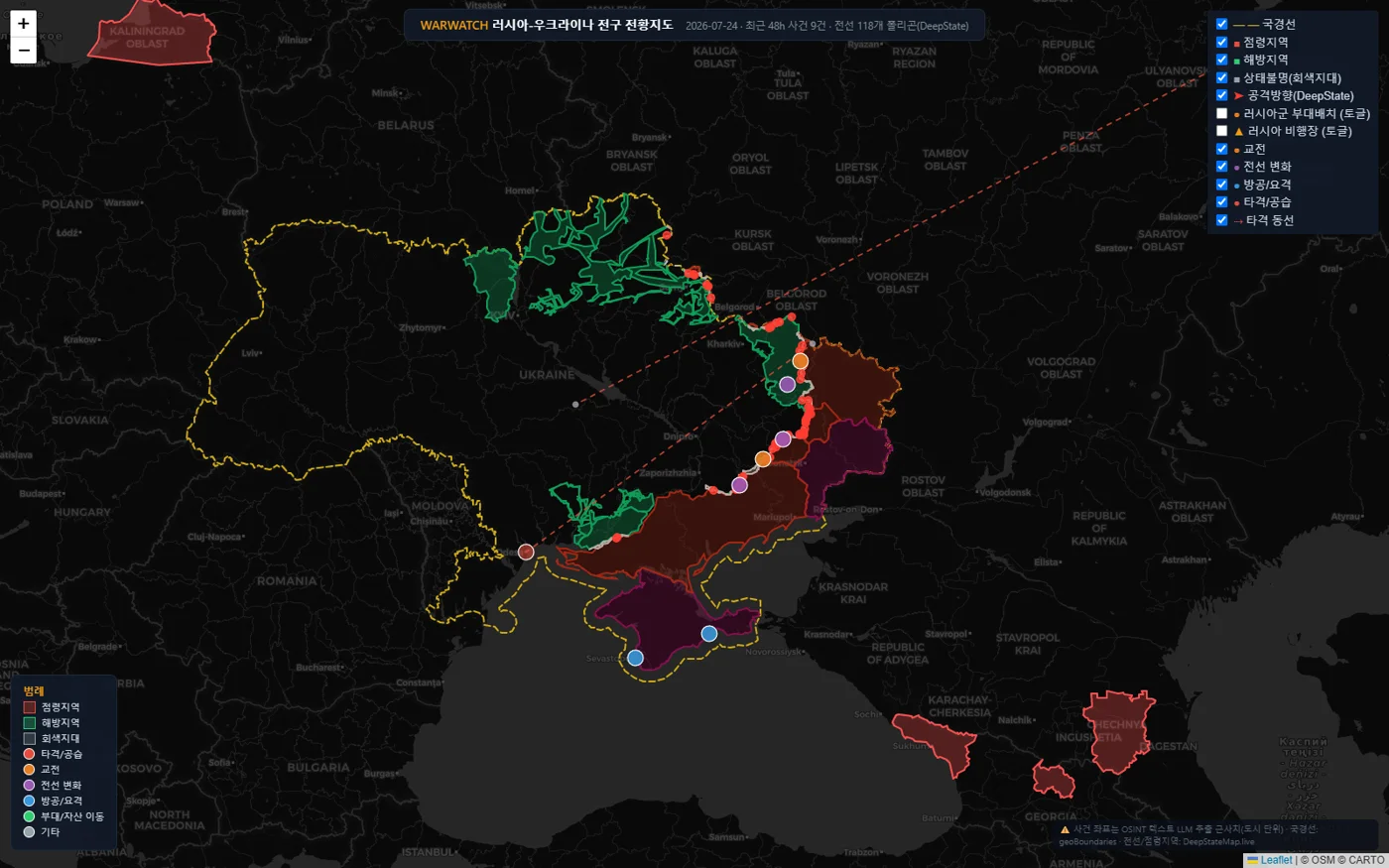
First, the eastern front. By the map and by the data, the ground war is static. Over the past 48 hours there are effectively no credible reports of front-line upheaval. Ukraine (pro-Ukraine DeepStateUA) briefly said only that it repelled the enemy near Filiia, with no detail. What has heated up is the sea. A naval unmanned-surface-vessel (USV) war has risen as the main axis of conflict. In the Black Sea, combat between Ukrainian USVs and Russia’s “shadow fleet” logistics ships is already routine (both sides admit it → high reliability), and Russia’s side (pro-Russia rybar) newly claimed that “Ukraine is deploying suicide USVs from merchant vessels in the Atlantic” (Russia one-sided, unconfirmed). If true, it signals maritime drone war spilling beyond the Black Sea into the open ocean.
At the same time, Russia said it is continuing a large campaign of strikes on Ukraine’s gas stations and energy infrastructure (Russia one-sided, no Ukrainian rebuttal or verification). Over Crimea’s Sevastopol and Feodosia, there were claims of repelling Ukrainian night drone attacks. In sum, the Russia-Ukraine front today is “ground stalemate + intensifying unmanned war at sea and in the air.” In the map below, the red occupied and green liberated boundaries are nearly frozen, while the air-defense and strike markers over the Black Sea and Crimea show where the real battlefield now is.
Middle East — 13 Straight Nights of Strikes, Yet No Decision
Shift to the Middle East and the intensity is far higher. Per US Central Command (CENTCOM), the US has struck Iran for 13 consecutive nights (neutral channel ClashReport + CENTCOM statement → high reliability). Even B-1 long-range bombers were used, with explosions reported in Ahvaz, Khuzestan, and along the Suza coast of Qeshm Island. Recall that a “14-point ceasefire memorandum” nearly got signed in June — that memorandum is now utterly a scrap of paper. Iran claimed, with satellite imagery, that it struck the US command at Ali Al Salem Air Base in Kuwait (pro-resistance Al Mayadeen, one-sided, unconfirmed), but all Kuwait’s military officially confirmed was a drone attack on a border post with Iraq.
Two things stand out. First, the US is paying a price too. Per neutral reporting, about 100 US troops have been wounded since early July, with a dozen-plus evacuated to a US military hospital in Germany, and an “airbridge” of heavy transports (C-17s and others) from Europe to the Middle East has been reactivated. Second, the chokepoint hit the global economy. With the Hormuz tanker war grinding on, oil surged past $100 a barrel. Iran’s parliament speaker Ghalibaf mocked on X that “they wanted to punish Iran and punished themselves with triple-digit oil.” Trump said future damage to ships and cargo would be “paid from Iranian funds the US has seized.” Meanwhile, the US House passed a (nonbinding) resolution urging an end to the Iran war and a troop withdrawal — a sign of domestic fatigue.
Gaza and the West Bank are not quiet either. Reports (pro-Palestinian QudsNen, one-sided) described a home detonated in Gaza City’s Al-Zaytoun and an airstrike on the Al-Maghazi camp, while arrests of Palestinians rose in the West Bank. Around 2,300 settlers entered the Al-Aqsa Mosque compound in Jerusalem (both sides acknowledge → high reliability). In the Middle East map below, the strike-axis lines linking Israel-Lebanon, Iran, and the Gulf (Hormuz) show at a glance how widely the front now stretches.

Overlay the Two Maps — Three Things in Common
Different theaters, yet the two wars now share the same three grammars. First, it’s a war of narrow necks. For the Middle East it’s Hormuz; for Russia-Ukraine, the Black Sea and now Atlantic lanes. Rather than pushing a broad front, gripping the narrow neck through which world logistics passes shakes the whole economy beyond the battlefield. Oil at $100 and threats to grain exports are the proof. Second, it’s an unmanned war. Cheap naval USVs and drones threaten expensive warships, tankers, and infrastructure. Asymmetry is rewriting the grammar of war. Third, it’s an attrition war with no decision. Firepower pours down, but there’s no decision on the ground. War hardens from an “event to be ended” into a “state to be managed.”
I think the third is most important. In my earlier piece on why the US-Iran war won’t end, I saw that war heading toward a “managed forever-war,” and the Russia-Ukraine front is on essentially the same trajectory. Both are not “wars to be won” but “wars that won’t end.”
The two maps point to one conclusion. The era of pushing ground fronts is fading, and the era of “bleeding the other side” through chokepoints and unmanned weapons has arrived. That’s why these wars rarely end — and why their cost spills over into the world beyond the battlefield.
Even Superpowers Tire — Firepower Isn’t Victory
The signal I watched most in this data is “superpower fatigue.” Even the world’s strongest military doesn’t have an infinite magazine. The US Army placed its first new order for the older PAC-2 GEM-T Patriot missile in over 30 years (neutral reporting). Buying the older model over the superior PAC-3 means air-defense stockpiles are that depleted — with an estimated well over 1,000 fired. Add the wounded evacuations, the reactivated airbridge, and the House withdrawal resolution, and the picture is clear: an edge in firepower does not mean the end of a war.
Of course, caution is due. Much of the above passed through biased OSINT channels, and the US military remains the world’s strongest. Trump was confident that “the Iran War is going better than expected.” But between the declaration “it’s going well” and the reality of scraping stockpiles to reorder an older missile, there’s a gap — and I read that gap. A tiring superpower isn’t defeat; it means the war is longer and more expensive than expected.

The Signal to Korea — A Bill and a Lesson
These two maps send Korea two things. One is a bill. Oil at $100 hits prices and the trade balance, and chokepoint risk in Hormuz and the Black Sea passes through freight rates and war-risk insurance back into import prices. If the Black Sea is blocked, grain prices wobble, rippling into global food inflation. For Korea — which produces not a drop of oil and imports its raw materials — this is no distant spectacle.
The other is a lesson. What both wars prove is that a cheap USV or drone can neutralize an expensive asset — the age of asymmetry is here — and that “ammunition stockpiles” like air-defense missiles determine a war’s staying power. For Korea, surrounded by sea on three sides and on the front line of missile and drone threats, this is worth engraving. When the shape of the battlefield changes, the shape of preparation must change too.

My Conclusion — Two Different Maps, One Shape
To sum up. Overlay the maps of two completely different wars — Russia-Ukraine and the Middle East — and the same shape appears. The ground fronts freeze, the fight shifts to sea, drones, and narrow necks, and neither side reaches a decision. It’s not an age of firepower but of attrition and fatigue. And the cost of that attrition flows to us beyond the battlefield in the form of oil, grain, insurance, and prices.
One last emphasis. Much of the information I cited today passed through belligerent channels, so it must be read by separating “verified / one-sided claim / unconfirmed.” Even so, the skeleton that neutral channels and both sides jointly acknowledge — 13 straight nights of strikes, oil past $100, intensifying maritime drone war, depleting superpower stockpiles — is enough to make the picture clear. Every dot on the map eventually comes back as a bill in our daily lives. That’s why I keep overlaying these two maps.
Frequently Asked Questions (FAQ)
The ground front is static, and the center of gravity has shifted to naval unmanned surface vessels (USVs) and drones. In the Black Sea, combat between Ukrainian USVs and Russian logistics ships is routine (both sides admit it), and Russia claims Ukraine is now deploying USVs from merchant vessels in the Atlantic (Russia one-sided, unconfirmed). Russia says it is continuing strikes on Ukraine’s gas stations and energy infrastructure.
After June’s ceasefire memorandum collapsed, the US has struck Iran for 13 consecutive nights per CENTCOM (B-1 bombers used). The Hormuz tanker war pushed oil past $100 a barrel; about 100 US troops have been wounded with some evacuated to Germany; and air-defense stockpiles are so depleted the US reordered an older Patriot missile for the first time in 30 years. The US House passed a nonbinding withdrawal resolution.
Three things: (1) a “chokepoint war” that grips narrow necks (Hormuz, the Black Sea, Atlantic lanes); (2) an “unmanned, asymmetric war” where cheap USVs and drones threaten expensive assets; and (3) an “attrition war” with pouring firepower but no decision. Both are hardening into “wars that won’t end” rather than “wars to be won.”
Oil at $100 pressures prices and the trade balance, and chokepoint risk in Hormuz and the Black Sea passes through freight and war-risk insurance into import prices. A blocked Black Sea shakes grain prices too. At the same time, the asymmetric threat of USVs and drones, and the importance of air-defense stockpiles, offer direct lessons for the defense of a country surrounded by sea on three sides.
Note on Sources
This piece summarizes and restructures a WARWATCH Telegram-OSINT auto-collected briefing (2026-07-24, Russia-Ukraine and Middle East theaters), noting each channel’s bias (pro-Russia rybar, pro-Ukraine DeepStateUA, pro-resistance Al Mayadeen, pro-Palestinian QudsNen, neutral ClashReport/WarMonitors). Core judgments weight items confirmed by neutral channels and both sides; one-sided and unconfirmed claims are marked as such.