Looking at the oil chart, one scene is strange. U.S. crude inventories are now 7% below the five-year average, and total stocks including the Strategic Petroleum Reserve are at their lowest in some 40 years, since 1984—yet WTI has dropped 22% in a single month, sliding to the $60s per barrel. Inventories are at rock bottom, but the price is cheap. It runs backward to common sense. Examining this contradiction, I reached a conclusion: what moves oil right now is not supply and demand but “politics.” And the hand on that political trigger reaches all the way to Beijing. That’s today’s story.
Let me state up front: the latter part of this piece—that China could use Iran as a lever to shake U.S. politics—is not a proven fact but my judgment woven from circumstances. Yet I’ll show, with grounds, that those circumstances are far from light—indeed that it’s quite likely.
Facts First — Cheap Price, 40-Year-Low Inventory
Start with the numbers. U.S. commercial crude inventories stood at about 412 million barrels in mid-June, 7% below the five-year average. The IEA warned that inventories are “depleting very fast, with cover measured in weeks, not months.” The physical market is clearly tight. Yet the price moved the opposite way. As Hormuz transits resumed—bringing Gulf exports back to roughly 75% of prewar levels—as Saudi Arabia signaled a ramp-up, and as the market pulled forward a 2026 global surplus, WTI slid into the $60s.
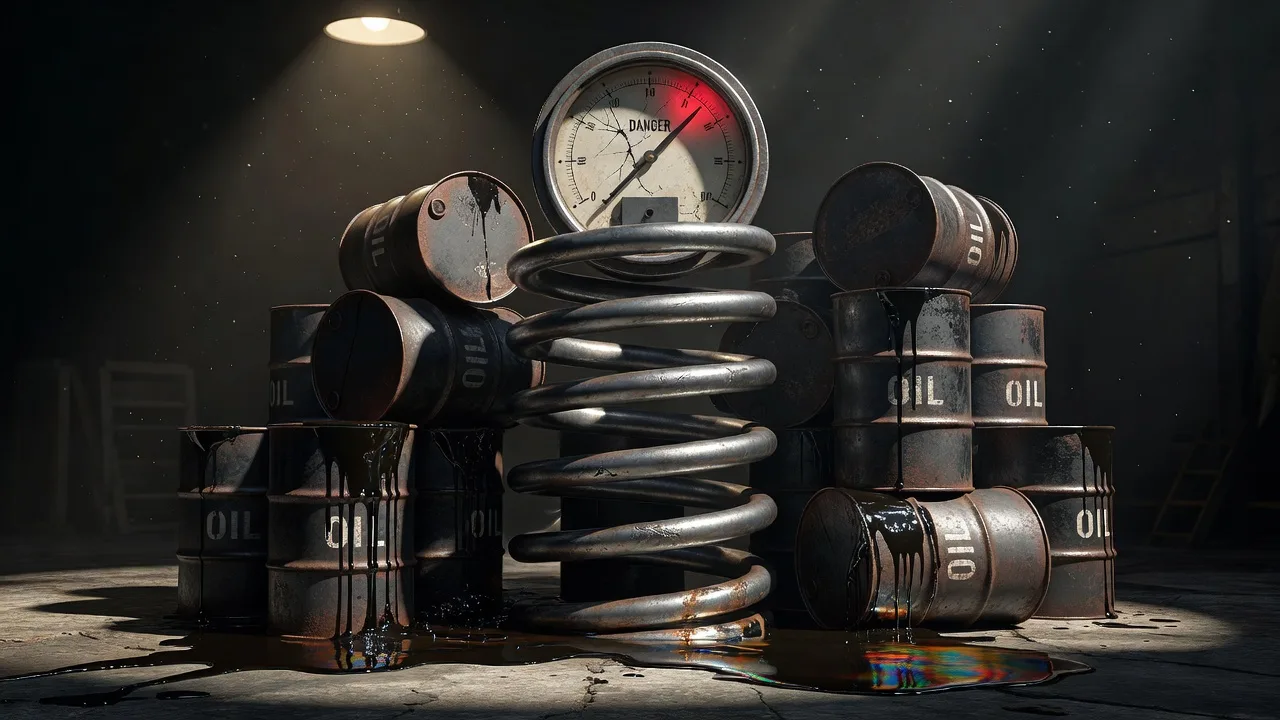
In other words, today’s cheap oil is not because the physical loosened, but a price betting on the future narrative that “the ceasefire holds and a surplus is coming.” The futures curve in backwardation (near-month premium) is the proof. The market knows it’s tight right now; it simply treats the crisis as “short-term” and presses the absolute level down. I call this a “coiled spring.” Inventory at a 40-year low, spare capacity thinning—yet the price lies low, assuming calm. Only the potential to leap is stacking up, ready for the moment the premise breaks.
The Trigger Is Politics, Not the Market — the Midterms
So who guards that premise, the “calm”? I believe America’s political calendar sits at its center. November 3—the midterm elections. For a sitting president and ruling party, no variable touches votes as intuitively as the price at the pump. Cheap gasoline is a political asset; a price spike instantly becomes a liability. So the White House has a strong incentive not to blow up Hormuz before the election, to limit retaliation to military and maritime infrastructure, to keep tankers transiting, and to hold oil prices down.
America’s moves these past weeks fit exactly this pattern. When Iran struck ships, it hit back in limited fashion but avoided escalation; the Navy even widened the Hormuz transit lane to keep oil flowing. The big picture is “manage the battlefield, keep it low-intensity until November.” So I think 2026 most likely flows on like this in broad strokes. But there’s a decisive caveat: this calm is America’s “will,” not America’s “control.”
Managing the battlefield doesn’t mean I control the board. It means the other side reads it too. The very fact that I want calm becomes, for the adversary, information that raises the price of coercion. Anyone who has planned operations in the military knows—the moment you assume the enemy doesn’t know your weakness, that plan is already half lost.
The Hand on the Trigger — It Reaches Beijing
Here’s the core. The wildcard that can break this calm is Iran’s response. But Iran does not decide its response alone. In an earlier piece I called the China-Iran relationship “managed alignment.” China buys 80–90% of Iran’s crude, shields it from sanctions, and covers it diplomatically. Iran struggles to survive without China. So the side that effectively holds the hilt of the blade that is Iran is closer to Beijing. That means the card of shaking Hormuz through Iran’s response—and shaking U.S. domestic politics with that oil price—lies, in theory, in China’s hand.
At first I too wondered, “Would China really go that far?” But looking at U.S.-China relations now, that suspicion is hard to set aside.
Why I Think It’s Quite Likely — the Grounds
First, U.S.-China relations are now “merely patched, not repaired.” This year alone, tariffs spiked to 145% and 125% on both sides before a fragile May truce at 30% and 10%; in June, when the U.S. designated Chinese tech firms as military-linked, China voiced “strong dissatisfaction and firm opposition” and warned it would “resolutely and forcefully retaliate.” On June 22, China put America’s flagship rare earth firms back on its export-control list. Beneath the surface truce, the level of hostility has actually risen. The deeper the hostility, the greater the incentive to shake the rival’s weak point.
Second, China already has both the will and the infrastructure to interfere in U.S. elections. This is not conspiracy theory but fact documented by multiple research institutes. China’s foreign-influence budget is estimated in the billions of dollars a year, with the United Front Work Department—tasked with co-opting elites—spending billions alone. The fake-account network known as “Spamouflage” has for years worked dozens of platforms to pry at America’s divisions—immigration, race, economic inequality—and now generates thousands of fake personas automatically with AI. The assumption that China keeps its hands off shaking U.S. politics is the unrealistic one.
Third, energy is the most powerful lever of all these means. Shaking the price at the pump is far more direct to votes than swaying opinion with fake accounts. And there’s one more decisive advantage. Influence operations draw backlash if caught, but oil-price pressure gets dressed up as “Iran’s doing.” China can reap the effect through Iran as a proxy hand without getting oil on its own. It’s a card with perfect plausible deniability. Motive (worsened relations), capability (the Iran lever plus the influence apparatus), opportunity (the midterm deadline)—the three now meet at a single point. So I move past “it could happen” to “it’s quite likely.”
Fourth, and most important—using energy as a political weapon is not hypothesis but history. In 1973, Arab oil producers imposed an oil embargo when the U.S. backed Israel in the Middle East war. Not pure market logic, but a weapon to punish and subdue the other side’s political choice. That one decision quadrupled oil prices and rocked the U.S. economy and politics. More recently, in 2022 Russia throttled the gas flowing to Europe, holding winter hostage to test Europe’s resolve to support Ukraine. Energy has always been the most powerful tool of political coercion. So the hypothesis that “China could shake U.S. politics with energy as a lever” is no new idea, but a reprise of a method history has proven many times. The only difference this time is that China borrows Iran’s hand rather than its own.

The Safety Pin Exists, but It’s Thin
Of course there’s a counterargument; I’ll note it fairly. The biggest safety pin is China’s own foot. China imports about 5.4 million barrels a day through Hormuz. If the strait fully closes, Chinese industry bruises before America’s. So what China can use is not an “explosion” but “finely calibrated pressure.” And if interference is clearly exposed, the strategic cost—tariffs, sanctions, alliance cohesion—could exceed a few points of votes.
But I think this pin is thinner than it looks. First, what China seeks is not to close Hormuz permanently. In the months before the election, it only needs to make it “intermittently” wobble enough to shake U.S. politics. A narrow band that harasses the rival enough without severing its own oil line—that is the essence of “managed alignment.” Second, the exposure problem is solved by the proxy hand that is Iran. Every action is recorded as Iran’s provocation; Beijing’s fingerprints don’t remain. Yes, the pin exists. But it is thin enough for China to bypass if it chooses.
So What Should the Trump Administration Do
So what should preparation be? I don’t think hardline retaliation is the answer. The real answer is “building an unshakable structure that drops the price of coercion itself to zero.” Even if the enemy holds the oil card, if that card doesn’t work on U.S. politics, the card is neutralized. Three things specifically.
First, refilling the Strategic Petroleum Reserve thickly. A thick reserve absorbs the shock of a temporary spike and blocks it from transmitting to votes. Second, the government becoming the insurer of last resort for war-risk coverage. Some governments have already moved this way. Even if insurance freezes, government backing keeps tankers sailing and prevents the worst “no one can receive oil” scenario. Third, pairing deterrence with back channels—signaling clearly that “striking a tanker brings a firm, predictable cost” while keeping a line open to prevent involuntary escalation by miscalculation. On top of this, tracking and exposing foreign energy and information operations as a matter of election security is needed too.
This is not a prescription for one camp’s victory, but a matter of the principle that foreign manipulation of one’s own elections must be blocked. Still, what’s clear is that the responsibility to prepare now rests with the current administration. A government that hardens its energy flank is strong against external shaking; one that doesn’t staggers at a single blow to gas prices in November.
My Conclusion — 2026 Is a ‘Calm with an Expiry Date’
To sum up. The big picture of 2026—”manage the battlefield, stay low-intensity until the election”—is the most plausible. I agree that far. But that calm is not permanent stability; it’s a respite with a November deadline. On that respite lies a coiled spring (40-year-low inventory), and the hand on that spring’s trigger reaches through Tehran to Beijing. As long as worsened U.S.-China relations, a proven influence apparatus, and an energy lever with perfect deniability meet, I think China is quite likely to keep fingering that card.
So the conclusion returns to preparation. The surest way to block shaking is not to be shaken. Refill the reserve, backstop insurance, set deterrence, track the operations. Only those who know this calm has an expiry date build the rampart before the deadline ends. Not the one who waits for the end, but the one who endures even if it doesn’t end, wins. Until November—and beyond.
Frequently Asked Questions (FAQ)
Because it’s a price betting on a future narrative, not the physical loosening. Resumed Hormuz transits, Saudi ramp-up signals, and a 2026 surplus outlook pressed prices down. The futures curve is in backwardation (near-month premium): the market knows it’s tight now but treats the crisis as “short-term” and keeps the absolute level low. It’s a “coiled spring” that leaps once the premise breaks.
It’s not a proven fact but a circumstantial inference. Yet those circumstances aren’t light: worsening U.S.-China relations (tariff war, military-entity designation, rare earth re-listing), China’s documented U.S. election-influence apparatus, the China-Iran “managed alignment,” and energy’s powerful leverage all meet at one point. This piece therefore judges it “quite likely” while separating fact from inference.
Yes—that’s the biggest safety pin. China imports about 5.4 million barrels a day through Hormuz. So what China can use is not full closure but “finely calibrated, intermittent pressure”—a narrow band that wobbles things just enough to shake U.S. politics while protecting its own oil line. But that pin, in my judgment, is thin enough for China to bypass if it chooses.
Not hardline retaliation, but building an “unshakable structure.” Refill the Strategic Petroleum Reserve to absorb spike shocks, have the government act as insurer of last resort for war-risk so tankers keep sailing, pair deterrence with back channels, and track and expose foreign energy and information operations as election security. Drop the price of coercion to zero and the card is neutralized.