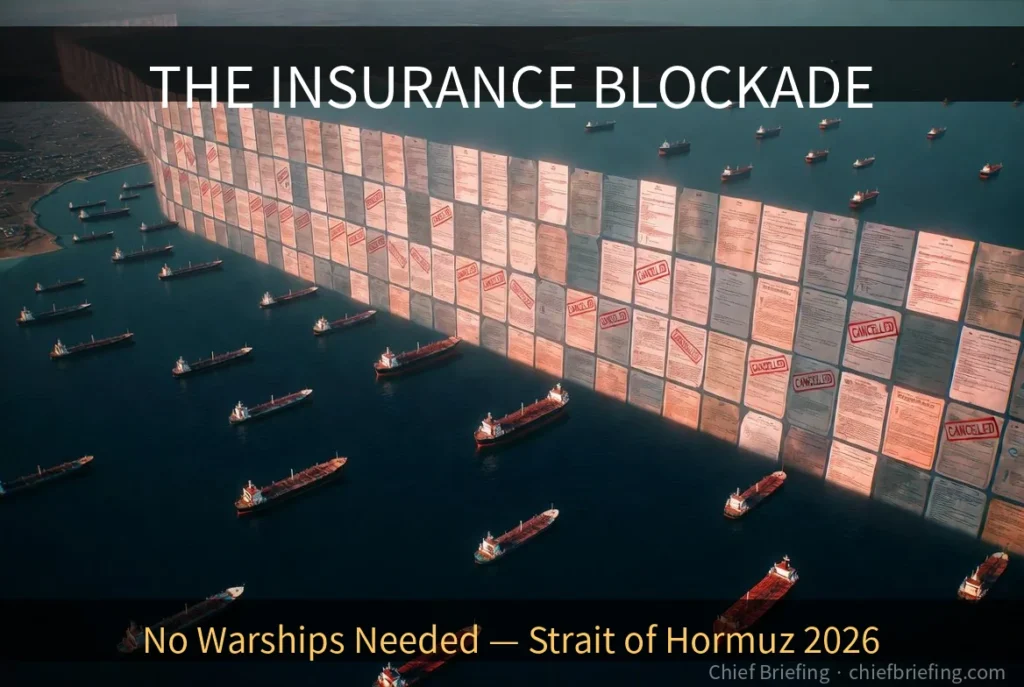
The Insurance Blockade. No insurance, no shipping.
In March 2026, when the London insurance market pulled war-risk coverage from the Strait of Hormuz, 400 tankers were stranded in the Persian Gulf.
Iran’s navy had been largely destroyed on the first day of US-Israeli strikes — yet the strait was effectively closed.
What sealed it shut was not missiles or mines, but the withdrawal of insurance.
• London’s Lloyd’s-centered marine insurance market triggered blanket NOC (Notice of Cancellation) on Hormuz war-risk policies, effectively blockading the strait without a single warship.
• The US responded within days: DFC (Development Finance Corporation) + Chubb launched a $20 billion government-backed reinsurance program.
• China’s Hong Kong market is simultaneously entering the war-risk space, creating a three-way race that could end London’s 330-year maritime insurance monopoly.
What Is a Maritime Insurance Blockade?
Maritime war-risk policies contain an automatic trigger. When hostilities erupt, insurers and reinsurers can cancel existing contracts within 72 hours through a Notice of Cancellation (NOC), then demand re-enrollment at dramatically higher premiums — or refuse to underwrite entirely.
On February 28, 2026, the US-Israeli coalition launched strikes on Iran. On March 3, the Lloyd’s Market Association’s Joint War Committee (JWC) designated the Persian Gulf, Gulf of Oman, Arabian Sea, and Gulf of Aden as Listed Areas for war-risk purposes.
That single decision repriced every war-risk policy in the region overnight.
1. JWC designates Listed Area → war-risk NOC auto-triggers
2. Reinsurers refuse new coverage or raise premiums 5–10x (from 0.25% to 1–3% of hull value)
3. Shipowners cannot secure insurance → ports refuse entry, charterers refuse cargo
4. Uninsured vessels cannot legally operate on international routes → de facto blockade
Result: Hormuz tanker traffic dropped 92% (Kpler, March 12) — without a naval blockade.
The critical insight is this.
Iran’s navy was effectively destroyed within hours of the first strikes. But sporadic drone and anti-ship missile attacks from Iranian shores kept insurers’ risk assessments at “uninsurable” levels.
This was not a military blockade — it was a financial one.
Maritime Insurance: London’s 330-Year Monopoly Structure
To understand London’s dominant position, one must understand its structure.
Lloyd’s of London — A Market, Not a Company
Founded in Edward Lloyd’s coffeehouse in 1688, Lloyd’s of London is not an insurance company but a marketplace of dozens of syndicates.
Risks are shared through a subscription model where multiple syndicates each take a portion of a policy.
This structure allowed the market to absorb catastrophic war losses that no single insurer could bear alone.
P&I Clubs — Shipowners’ Mutual Insurance
Protection & Indemnity insurance — covering shipowner liability — is dominated by 13 P&I Clubs (Gard, NorthStandard, Britannia, etc.).
These are non-profit mutual associations owned by shipowners themselves.
Because they operate at cost rather than for profit, commercial insurers like Chubb or AIG could never compete on price.
The Lock-In Effect of the UK Marine Insurance Act (1906)
Global marine insurance operates under the UK Marine Insurance Act 1906. Dispute resolution defaults to London arbitration. Three centuries of accumulated case law, policy language, loss data, and legal infrastructure created a gravitational pull that made alternatives virtually impossible.
• Mutual vs. shareholder structure: P&I Clubs are non-profit; commercial insurers cannot undercut them
• Extreme volatility: Years of quiet premiums, then billions in claims from a single conflict — quarterly earnings poison for public companies
• 330 years of loss data: New entrants face actuarial blindness
• Syndicate risk-sharing: No single company can replicate Lloyd’s distributed structure
Maritime Insurance, America’s Response: The DFC + Chubb $20 Billion Program
When London stepped back, Washington stepped in. On March 3, President Trump simultaneously announced two measures on Truth Social.
1. DFC Government Reinsurance
Trump ordered the US International Development Finance Corporation (DFC) to provide political risk insurance and guarantees for all maritime trade through the Gulf “at a very reasonable price.”
On March 11, Chubb was named lead underwriter. The structure:
Chubb: Issues policies directly to shipowners — the “front desk”
DFC: Provides $20 billion in rolling reinsurance behind Chubb
US Government: Ultimate loss bearer (i.e., American taxpayers)
A DFC official admitted candidly: “DFC doesn’t have actuaries ourselves. We don’t have the staff to be the focal point for the market.”
In other words, Chubb is not taking risk with its own capital — it is earning underwriting fees under a government guarantee.
2. US Navy Tanker Escorts
Trump also announced that the US Navy would escort tankers through Hormuz “if necessary.”
However, the reality is far from simple. The Navy currently has only 9 destroyers and 3 littoral combat ships in the Arabian Sea — far too few to escort 400 stranded tankers.
• $20B vs. $352B gap: JPMorgan estimates 329 Gulf vessels need ~$352 billion in total coverage. DFC covers 5.7% of that.
• DFC statutory limit: $205 billion total risk exposure as of December 2025. Exceeding it requires an act of Congress.
• Narrow eligibility: Initially US-linked vessels and strategic commodities (crude, LNG, gasoline, jet fuel, fertilizer) only.
• Physical safety unresolved: NorthStandard P&I Club — “Size is not the issue. It is the current factual unsafety of the transit.”
Maritime Insurance Three-Way Race: London vs. Washington vs. Hong Kong
This crisis may not end with the war. The maritime insurance market is fragmenting in three directions.
London — A Crack in 330 Years of Trust
London’s market abandoned its core function — underwriting risk — at the moment of greatest need.
The NOC was contractually valid, but it branded London with a reputation problem: “They run when it gets real.”
That perception will outlast the war.
Washington — The Military-Insurance Package
The United States is the only power that can bundle the world’s largest navy, the dollar reserve currency, and satellite/cyber intelligence into a single insurance product.
If the US institutionalizes the DFC model — military escort + sovereign reinsurance + real-time surveillance — it creates a product London structurally cannot match.
The strategic incentives for permanence are compelling:
Sanctions enforcement: Own insurance market → direct control over Iran/Russia maritime sanctions
Dollar hegemony: Insurance premiums denominated 100% in USD
Intelligence advantage: Underwriting data (routes, cargo, ownership) feeds directly into naval/intelligence systems
Alliance leverage: “Buy our insurance, get our navy” as a tool of alliance management for energy importers like Korea, Japan, and India
Hong Kong — The Eastern Alternative
China is already undercutting London through Hong Kong-based insurers.
Sanctioned vessels and Russia/Iran-linked ships — locked out of London — are finding coverage in Hong Kong.
Chinese banks are accepting Hong Kong-issued war-risk policies as valid collateral for ship financing, and the old rule of “London or nothing” is breaking down.
Western Tier (US/London): Higher premiums, strict sanctions compliance, Lloyd’s/DFC sovereign backing
Eastern Tier (Hong Kong/China): Aggressive pricing, flexible compliance, Asian sovereign capital
For shipowners, choosing an insurer is no longer just a financial decision — it is a geopolitical alignment.
How the Maritime Insurance Shift Affects Korea
South Korea depends on the Middle East for roughly 70% of its crude oil imports.
This insurance blockade exposed ₩1.69 trillion in domestic maritime insurance risk, and war-risk premiums surged 5–10x.
The Financial Supervisory Service urgently convened CFOs from 14 insurers for this reason.
More structurally, the reshaping of the maritime insurance market forces Korean shipping and energy companies into a new choice. Joining the DFC program offers the benefit of US Navy escorts — but means integration into a US-centered insurance regime. Using the Hong Kong market lowers costs — but exposes companies to Western sanctions risk.
For the military background of this crisis, see US-Iran War Probability Analysis. For the impact on commodity markets, see US-China Raw Materials War: 6-Round Showdown.
For the impact of surging oil prices on the Korean stock market (KOSPI) from a retail investor perspective, visit Atomic Economy Blog.
Maritime Insurance Is Power
Maritime insurance is not a financial product. It is an instrument of sea power.
Britain maintained the shadow of maritime hegemony through insurance long after its navy declined. This crisis cracked that last pillar.
Whether the US treats the DFC program as a wartime expedient or develops it into a permanent maritime insurance regime will be a defining variable in the post-war maritime order.
If Washington institutionalizes a “naval escort + sovereign reinsurance + satellite surveillance” package, it would represent the most significant restructuring of maritime financial architecture since Bretton Woods.
Frequently Asked Questions
An insurance blockade occurs when insurers and reinsurers withdraw war-risk coverage from a maritime region, making it impossible for commercial vessels to operate legally. Since international shipping requires valid insurance for port entry, cargo loading, and route navigation, the withdrawal of coverage creates a de facto blockade without naval forces.
No. The DFC program is currently limited to war-risk coverage for strategic commodities transiting the Strait of Hormuz. Conventional hull, cargo, and P&I (shipowner liability) insurance must still be obtained from the London market. However, if the conflict is prolonged, the program could evolve into a permanent institution.
No. Chubb acts as the policy-issuing front end. Actual losses are absorbed by the DFC’s $20 billion rolling reinsurance facility, ultimately backed by the US government — meaning American taxpayers bear the risk.
The DFC program initially targets US-linked vessels and strategic commodities (crude, LNG, gasoline, jet fuel, fertilizer), but President Trump stated it would be open to “all shipping lines.” Specific eligibility can be confirmed by contacting the DFC directly (maritime@dfc.gov).
Hong Kong-based insurers offer significantly lower premiums, underwrite sanctioned vessels that London refuses, and operate with implicit backing from Chinese state-adjacent capital. However, using Hong Kong war-risk coverage may expose shipowners to Western sanctions risk.