Ukraine war situation: In June 2026, the front lines are hotter with ‘information’ than with gunfire. Channels from both sides pour out massive enemy casualties on one hand and plots and chaos in the opponent’s rear on the other. Yet verifiable information on where and how much the front has moved remains scarce. This article takes no side. It separates ‘cross-verified’ from ‘one-sided claims’ in open-source intelligence (OSINT), outlines the real contours that emerge — the war of attrition around the Black Sea — and comments on how to read this war shrouded in an information fog.
- The current Ukraine war situation is summarized as a ‘war of attrition and stalemate + intensified information warfare.’ Reports of decisive front-line changes on a 24–48 hour cycle are rare.
- The core element confirmed through cross-verification is the Black Sea — Ukraine’s drone strikes on Crimean and Sevastopol infrastructure, and Russia’s Sevastopol fuel shortages and domestic energy deficits.
- The land front has been in stalemate since Russia captured Pokrovsk (early 2026), with no meaningful further advances westward according to ISW assessments.
- One-sided claims must be treated as one-sided — figures such as ‘200,000 casualties’ or rear-area conspiracy theories originate from single channels and lack independent confirmation.
- Both sides have reduced tactical reporting and shifted focus to ‘narrative competition.’ This information vacuum itself is a warning sign.
- To read the situation neutrally, prioritize verifiable indicators (Black Sea logistics and fuel, third-party assessments) and set aside one-sided figures.
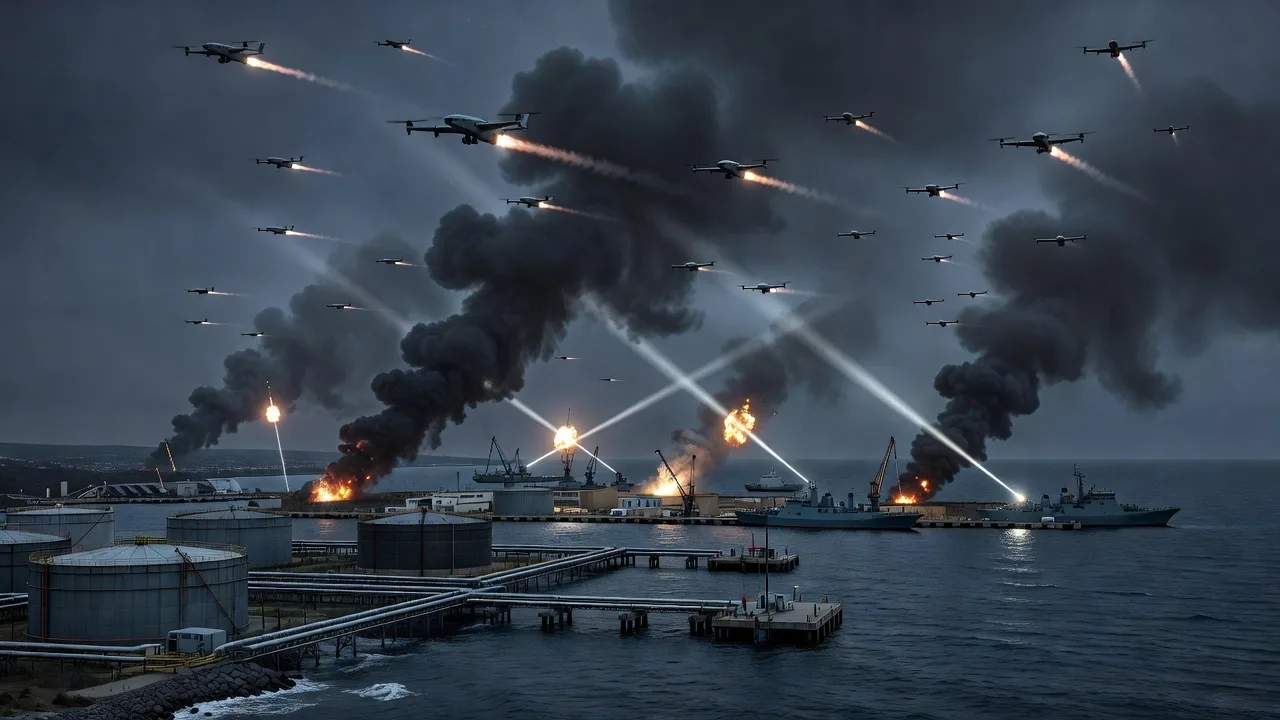
Ukraine war situation — verified versus claimed
The first principle for reading the war situation is to separate sources. Pro-Ukraine and pro-Russia channels paint the same day in entirely different pictures. Relying on only one side therefore tilts the view. The key task is to distinguish events that both sides ‘simultaneously acknowledge’ from claims that ‘only one side trumpets.’ By this standard, the confirmed contours of the current Ukraine war situation are surprisingly narrow.
Cross-verified core — Black Sea and Crimea attrition
The single strand both sides’ channels jointly acknowledge is the Black Sea. Since June, Ukraine has repeatedly struck Crimean and Sevastopol energy and logistics infrastructure with nighttime drones, and Russian sources have acknowledged attacks ‘including jet-powered drones.’ At the same time, Russia’s Sevastopol fuel situation has deteriorated to the point where local officials have described it as ‘serious.’ Gasoline shortages and price increases in southern Russia are reported as structural rather than temporary. Thus the verifiable center of gravity in the Ukraine war situation lies not in ground breakthroughs but in the war of attrition targeting Russia’s Black Sea Fleet supply and fuel ‘logistics arteries.’ This thread continues in the drone-altered front and Russia’s fuel crisis.
One-sided claims remain one-sided
Conversely, claims that cannot be cross-verified must be handled with caution. Pro-Ukraine channels cite specific brigades’ annihilation operations and present enemy losses on the order of 200,000, arguing that ‘the war has come to resemble World War I’ — yet these originate from a single channel and comparisons can easily become exaggerated. Pro-Russia channels highlight chaos in the opponent’s rear (Western capital conspiracy theories, migrant tensions, vehicle explosions near Moscow) rather than the battlefield — content that is likewise difficult to confirm independently and carries propagandistic traits. Notably, even pro-Russia channels express self-deprecating remarks that ‘drones are the future, yet Russia lacks that future’ and signal declining domestic morale. Accepting figures from either side at face value leads to misreading the Ukraine war situation.
Ukraine war situation land front — stalemate after Pokrovsk
What, then, of the ground front? Third-party assessments are most useful here. Russia entered Pokrovsk in November 2025 and captured it together with nearby Myrnohrad in early 2026. However, the Institute for the Study of War (ISW) assesses that Russia has been unable to convert this capture into an operational breakthrough and has made no meaningful advances west of Pokrovsk since December 2025. Despite Kremlin claims of opening a ‘new major offensive’ across Donetsk, the actual front more closely resembles a slow war of attrition and stalemate. Even when one side gains a city, the balance of the war does not tilt decisively — a classic frozen phase.
Ukraine war situation and the fog of information — when propaganda obscures the front
The most prominent feature of the 2026 phase is that both sides have reduced ‘tactical combat reporting’ and shifted to ‘narrative competition.’ Pro-Russia channels flood the space with Western financial-capital conspiracy theories, British political turmoil, and geopolitical narratives about African resources instead of front-line maps. Pro-Ukraine channels emphasize symbolic metaphors and large-scale figures over concrete gains to boost morale. Both treat ‘information’ as a weapon. The problem is that as this fog thickens, outside observers find it increasingly difficult to gauge the actual front. An information vacuum is not merely an inconvenience; it can become fertile ground for miscalculation and escalation.
① Only events that both sides’ channels ‘simultaneously acknowledge’ are treated as fact. ② Casualty and gain figures from a single channel are classified as ‘claims.’ ③ Ground-front assessments prioritize third-party evaluations such as ISW. ④ Propagandistic content (conspiracy theories, symbolic metaphors) is separated from war-situation judgments. All ‘claims’ in this article must be read together with their source bias.
Commentary — how to read the Ukraine war situation
What follows moves beyond factual summary into interpretation. It concerns methods for finding direction in the fog, without taking sides.
Weight verifiable indicators
Enormous casualty figures or rear-area conspiracy theories stimulate emotion but do not indicate the war’s direction. Quiet numbers often reveal more: Sevastopol fuel stocks, vessel traffic on Black Sea routes, gasoline prices in southern Russia. The currently verifiable signals point in one direction — Ukraine is steadily pressuring Russia’s ‘logistics and energy.’ This does not appear clearly on territorial maps, yet it is the axis that determines endurance in a protracted conflict.
Continued attrition without decisive advantage
In the current Ukraine war situation, neither side holds a decisive advantage. Russia has gained cities yet failed to convert them into breakthroughs; Ukraine strikes the rear but cannot push the front back significantly. Both sides’ focus on information warfare is paradoxically evidence of this stalemate — the fewer decisive results to show on the battlefield, the greater the incentive to compete through narrative. Therefore, rather than dramatic short-term reversals, a war of endurance — who can sustain attrition longer — is likely to continue. What outside observers require is not one side’s victory bulletins but patient accumulation of verified signals.
Variables that could shift this stalemate are more likely to lie outside the front. First, the trajectory of external support: if direct U.S. assistance declines substantially and Europe assumes the gap, Ukraine’s endurance becomes more tightly bound to Europe’s political and financial will. Second, Russia’s internal fatigue: accumulated fuel burdens and morale decline in the south erode war-making capacity behind the lines. Third, external shocks such as the Middle East or energy markets: fluctuations in oil prices and geopolitics can alter both sides’ calculations. Reading the Ukraine war situation therefore requires watching the rear-area stamina and external support directions of both sides alongside the front-line map.
Related analysis worth reading
The structural changes wrought by drones and fuel continue in Ukraine-Russia war — the drone-altered front and Russia’s fuel crisis; great-power calculations mediated by energy and sea routes continue in Hormuz blockade and Northern Sea Route — Trump and Putin’s three puzzles.
📚 References
- Institute for the Study of War (ISW) — Ukraine war situation assessments
- Pokrovsk offensive (background)
- OSINT cross-verification: simultaneous comparison of pro-Ukraine (DeepState) and pro-Russia (Rybar) channels (bias correction)
This article neither supports nor condemns any belligerent party. It is an analysis intended to provide information based on cross-verification of open-source intelligence (OSINT) and third-party assessments. Battlefield information is inherently incomplete and mixed with propaganda from both sides; figures and claims in the text must therefore be received together with the timing and source bias. The situation can change rapidly.
Frequently asked questions (FAQ)
‘소모전 교착 + 정보전 격화’다. 24~48시간 단위의 결정적 전선 변화 보도는 드물고, 교차검증으로 확인되는 핵심은 흑해다 — 우크라이나의 크림·세바스토폴 인프라 드론 타격과 러시아의 세바스토폴 연료난·국내 에너지 부족이다.
어느 쪽도 결정적 우위를 쥐지 못했다. 러시아는 2026년 초 포크로브스크를 점령했지만, ISW 평가상 이를 작전적 돌파로 전환하지 못하고 서쪽 진격이 정체됐다. 우크라이나는 후방을 타격하지만 전선을 크게 되밀지는 못하는 교착 상태다.
신중해야 한다. 그런 수치는 대개 단일 채널(한쪽 진영) 발이며 독립적 확인이 없다. 이 글은 양측이 동시에 인정하는 사건만 사실로 보고, 일방의 사상자·전과 수치는 ‘주장’으로 분류한다.
양 진영 모두 전술 전투 보도를 줄이고 서사·선전 경쟁에 집중하고 있기 때문이다. 전장에서 보여줄 결정적 성과가 적을수록 정보를 무기로 쓰려는 유인이 커진다. 이 정보 공백은 오판과 확전의 위험을 키운다.
그렇다. 특정 당사국을 지지·비난하지 않고, 공개정보의 교차검증과 ISW 등 제3자 평가에 기반한다. 양측 채널의 편향을 함께 명시하고, 검증된 사건과 일방 주장을 구분해 제시했다.