What Is the SaaSpocalypse SaaS Crash?
The SaaSpocalypse SaaS crash began on February 3, 2026.
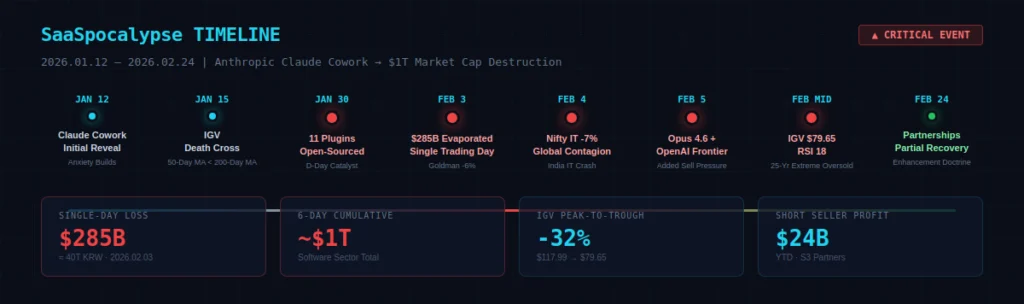
Triggered by Anthropic’s Claude Cowork plugin release, this massive selloff of enterprise software stocks evaporated approximately $285 billion (about 40 trillion KRW) in market capitalization in a single trading day.
Over six trading days, the cumulative destruction reached $1 trillion (about 130 trillion KRW). Named by Jefferies trader Jeffrey Favuzza — combining “SaaS (Software-as-a-Service)” and “Apocalypse” — this event represented the market’s first structural repricing of the threat AI agents pose to subscription-based software business models.
This article dissects the SaaSpocalypse SaaS crash from catalyst to the 3-stage mechanical selloff chain of algorithms, ETFs, and short sellers, including recovery scenarios and remaining structural questions.
The SaaSpocalypse SaaS crash was the market’s first structural reassessment that AI agents fundamentally threaten existing SaaS business models.
SaaSpocalypse SaaS Crash Catalyst: Claude Cowork’s 11 Plugins
Catalyst Part 1: January 30 — One GitHub Repo That Burned $1 Trillion
On January 30, 2026, Anthropic released 11 industry-specific plugins for Claude Cowork under the Apache-2.0 license on GitHub. No press conference. No fanfare. Just a blog post and a code repository.
But the plugin contents were enough to shake the market’s foundational assumptions. The legal plugin performed automated contract review, NDA classification, compliance checks, and legal briefing generation. The sales plugin handled CRM integration, prospect research, and personalized outreach drafting. The finance plugin automated modeling and metric tracking.
The critical point: these weren’t “chatbots” — they were “agents.” Claude Cowork implemented “Agentic Execution,” autonomously opening files, logging into enterprise tools, and performing multi-step tasks. Anthropic’s enterprise product lead Scott White described it as “vibe working” on CNBC.
The same day, CNBC journalists built a Monday.com clone in one hour using Claude Code (Source: Serenities AI). Cost: $5–15. Core features of enterprise software built over decades with billions of dollars were replicated for the price of a coffee.
Catalyst Part 2: The Signal Markets Read — Foundation Model Company Descends to Application Layer
Jefferies issued an immediate analyst note. The core message was clear: Anthropic was no longer just supplying AI models to other companies — it was building complete workflow solutions directly. The era of foundation model companies competing head-to-head with application layer companies had begun.
If specialized software built over decades becomes just another feature in a general AI subscription, does LegalZoom need to exist? What about Thomson Reuters’ premium data services? Market analysts called it “death by a thousand plugins.”
SaaSpocalypse SaaS Crash Root Cause: Per-Seat Model Structural Collapse
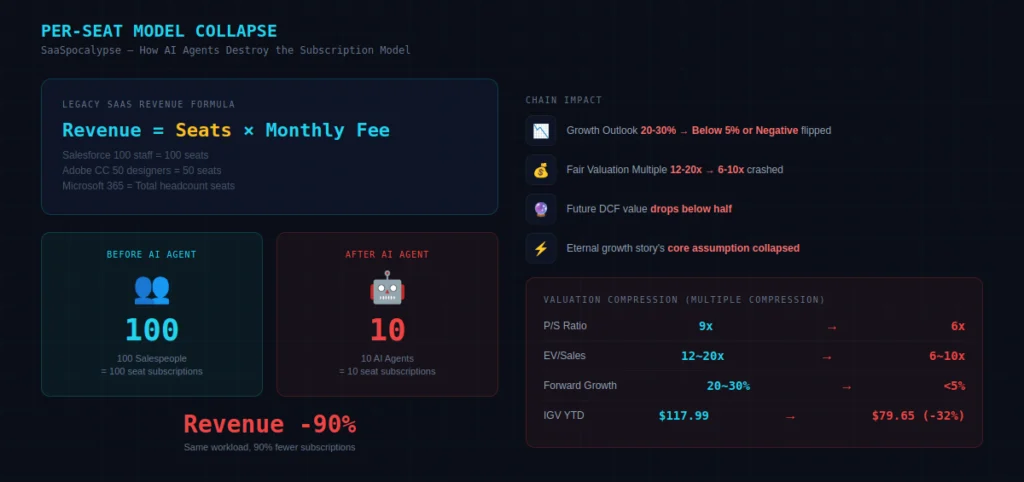
The real cause behind the SaaSpocalypse SaaS crash is the structural collapse of the Per-Seat model. To understand the crash, start with the SaaS revenue formula:
Revenue = Number of Seats (users) × Monthly Subscription Fee
Salesforce sells 100 seats for a 100-person sales team. Adobe Creative Cloud sells 50 seats for 50 designers. Microsoft 365 sells seats equal to total headcount. In this model, revenue growth equals seat growth, and investors awarded EV/Sales multiples of 12–20x based on this growth story.
AI agents attack the core variable in this formula. As SaaStr’s Jason Lemkin pointed out (Source: AI2Work), if 10 AI agents handle the workload of 100 salespeople, companies need only 10 seats instead of 100. A 90% revenue reduction. Same workload, 90% fewer subscriptions.
This is why markets read it as “existential threat to the business model” rather than mere competition. When growth projections flip from 20–30% to below 5% or negative, fair valuation multiples crash from 12–20x to 6–10x. The software sector’s Price-to-Sales ratio compressed from 9x to 6x — the lowest since the mid-2010s.
SaaSpocalypse SaaS Crash: The 3-Stage Mechanical Selloff Cascade
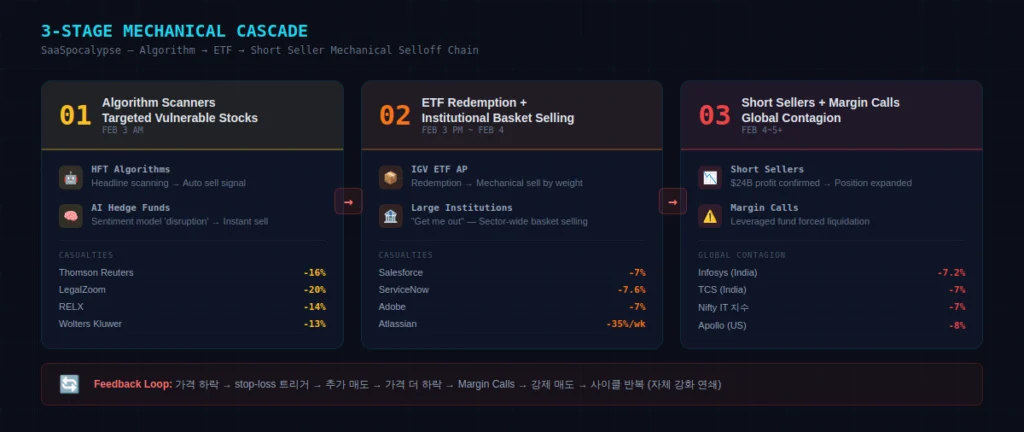
The $285 billion evaporation in the SaaSpocalypse SaaS crash was not emotional panic — it was a structural selloff chain of algorithms, ETFs, and short sellers. Each stage mechanically triggered by the previous stage’s price decline.
Stage 1: Algorithm Scanners → Targeted Strikes on Vulnerable Stocks (Feb 3 AM)
The first sellers were not human. As Anthropic news spread in European pre-markets, headline-scanning algorithms automatically detected “AI disruption” signals. High-frequency trading systems and AI hedge fund sentiment models immediately generated sell signals.
Strikes concentrated on the most vulnerable, liquid names — legal and data specialist software companies that AI could “nearly identically” replace.
Stage 1 Casualties
| Stock | Daily Decline | Notes |
|---|---|---|
| Thomson Reuters | -16 to 18% | Largest single-day drop in company history |
| LegalZoom | -19.7% | Legal SaaS direct hit |
| RELX (LexisNexis parent) | -14% | Legal data |
| Wolters Kluwer | -13% | Professional information services |
| FactSet | -10.5% | Financial data |
Stage 2: ETF Redemption + Institutional Basket Selling → Large-Cap Contagion (Feb 3 PM – Feb 4)
As legal/data stocks collapsed, capital outflows from software ETFs surged.
The iShares Expanded Tech-Software Sector ETF (IGV) recorded its highest trading volume in 25 years (Source: Investing.com). The ETF mechanism mechanically amplified selling. Goldman Sachs’ US Software Basket fell 6% in a single day (Source: Xpert Digital).
Stage 2 Casualties
| Stock | Daily Decline | Notes |
|---|---|---|
| Salesforce | -7% | CRM leader, 7.7% IGV weight |
| ServiceNow | -7.6% | IT workflow |
| Adobe | -7% | Creative subscription |
| Intuit | -11% | Accounting/tax software |
| Atlassian | -35% weekly | Project management |
Stage 3: Short Sellers + Margin Calls (Feb 4–5)
Short sellers earned $24 billion YTD from software stock shorts according to S3 Partners (Source: Philipp Dubach). Confirmed profits led to expanded positions. Leveraged funds hit margin calls and were forced to liquidate.
SaaSpocalypse SaaS Crash Global Propagation and Feedback Loop
India’s Nifty IT index recorded its steepest single-day decline since March 2020 at approximately 7% (Source: INVC). Institutional software exposure collapsed from 7% to a record-low 4.2%.
IGV fell approximately 32% from its September peak of $117.99 to $79.65. RSI dropped to 18 — the most extreme oversold level since 1990.
Feedback loop complete: Price decline → stop-loss triggers → additional selling → further price decline → margin calls → forced liquidation. This self-reinforcing cycle amplified the SaaSpocalypse SaaS crash magnitude.
After the SaaSpocalypse SaaS Crash: Recovery and Structural Questions
Anthropic’s ‘Enhancement Doctrine’
On February 24, Anthropic repositioned Claude Cowork as enhancing — not replacing — existing SaaS companies. Partnerships with Google Drive, Gmail, DocuSign, FactSet, Salesforce, and Intuit were announced (Source: FinancialContent).
Figma became the poster child, reporting Q4 revenue of $303.8M (40% YoY growth) after announcing its Anthropic Code to Canvas integration (Source: Nasdaq).
Structural Questions Remain
Goldman Sachs CEO David Solomon called the selloff “too broad” (Source: Motley Fool). NVIDIA CEO Jensen Huang dismissed the replacement thesis as “the most illogical thing in the world.”
My analysis identifies three core lessons:
First, structural pressure on per-seat models is real. The transition from “software as a tool” to “software as a worker” has already begun.
Second, the market reaction was excessive. The algorithm→ETF→short seller mechanical chain moved prices far faster and larger than fundamental changes warranted. IGV’s RSI of 18 suggests systemic overselling.
Third, the key to survival is the “data moat.” AI can replicate features, but not decades of proprietary corporate data and workflow context.
SaaSpocalypse SaaS Crash Timeline Summary
| Date | Event | Impact |
|---|---|---|
| Jan 12 | Claude Cowork initial reveal | Anxiety formation begins |
| Jan 15 | IGV death cross (50-day < 200-day MA) | Technical sell signals generated |
| Jan 30 | 11 industry plugins open-sourced | D-Day catalyst |
| Feb 3 | $285B market cap evaporated (single day) | Goldman Software Basket -6% |
| Feb 4 | India Nifty IT -7%, global propagation | Asian IT stocks crash |
| Feb 5 | Claude Opus 4.6 + OpenAI Frontier simultaneous release | Additional selling pressure |
| Mid-Feb | IGV $79.65 (peak -32%), RSI 18 | Most oversold in 25-year history |
| Feb 24 | Anthropic partnership announcements | Partial recovery begins |
Frequently Asked Questions (FAQ)
Is the SaaSpocalypse SaaS crash a temporary overreaction or structural change?
Both. The scale and speed of the selloff was excessive relative to fundamentals due to the mechanical algorithm→ETF→short seller chain. However, structural pressure on per-seat models is real, and software sector valuations are unlikely to fully recover to previous levels.
Which SaaS companies are most at risk from the SaaSpocalypse?
Companies dependent on narrow, single-function offerings (legal document review, basic data analysis, simple workflow automation) are most vulnerable. Those with proprietary data, deep enterprise integration, and high switching costs have relatively stronger defenses.
Can AI agents actually completely replace SaaS?
“Seat compression” is more accurate than “complete replacement” at this point. AI can replace software features, but not enterprise systems of record, regulatory compliance frameworks, or decades of accumulated data context.
What does the SaaSpocalypse mean for Korean investors?
Investors directly holding US SaaS stocks or Nasdaq ETFs should assess per-seat model dependency immediately. Domestic enterprise software companies like Samsung SDS and Kakao Enterprise also face business model transition pressure in the AI agent era.
Conclusion: From Software-as-a-Service to Outcome-as-a-Service
The SaaSpocalypse SaaS crash was not a simple stock correction. It was the first time markets priced in the transition from “selling software as a tool” to “software performing work directly.”
Algorithms lit the spark, ETFs mechanically fanned the flames, and short sellers spread the wildfire nationally. This 3-stage cascade reveals the structural vulnerability of modern financial markets — not emotional panic, but systems operating exactly as designed.
The critical question ahead is simple: Is the software company in your portfolio the “fuel tank” for AI agents, or the “replacement target”?
The SaaSpocalypse SaaS crash teaches that the eternal growth story of the per-seat model is over. What remains is the game of who successfully transitions to Outcome-as-a-Service.