Myanmar’s civil war, which began with the 2021 coup, shows no sign of ending even in 2026. The military regime is attempting to institutionalize its military rule by installing Min Aung Hlaing as president through the 2026 election, but resistance forces, including the Arakan Army, are instead expanding their territories and continuing the fighting.

Recent Developments (March–May 2026)
In March and April, the military recaptured parts of the Mandalay region and launched a counteroffensive, but on multiple fronts—including western Rakhine—the Arakan Army’s advance continued. The military’s strategy of “securing legitimacy through elections” is clashing directly with the resistance’s strategy of “effective territorial control.” Meanwhile, civilian displacement and the humanitarian crisis have only deepened.
The Structure of the Civil War — Military vs. Multiple Resistance Forces
Myanmar’s civil war is not a single-front conflict. People’s Defense Forces (PDF) formed in response to the coup, together with long-standing Ethnic Armed Organizations (EAOs) seeking autonomy, have loosely coordinated against the military. While the military holds advantages in air power and heavy weaponry, it has been unable to fully subdue resistance groups rooted in mountainous and jungle terrain. This explains the prolonged war of attrition between the military’s pursuit of nationwide control and the resistance’s efforts to expand “liberated zones.”
Humanitarian Crisis and Implications for Korea
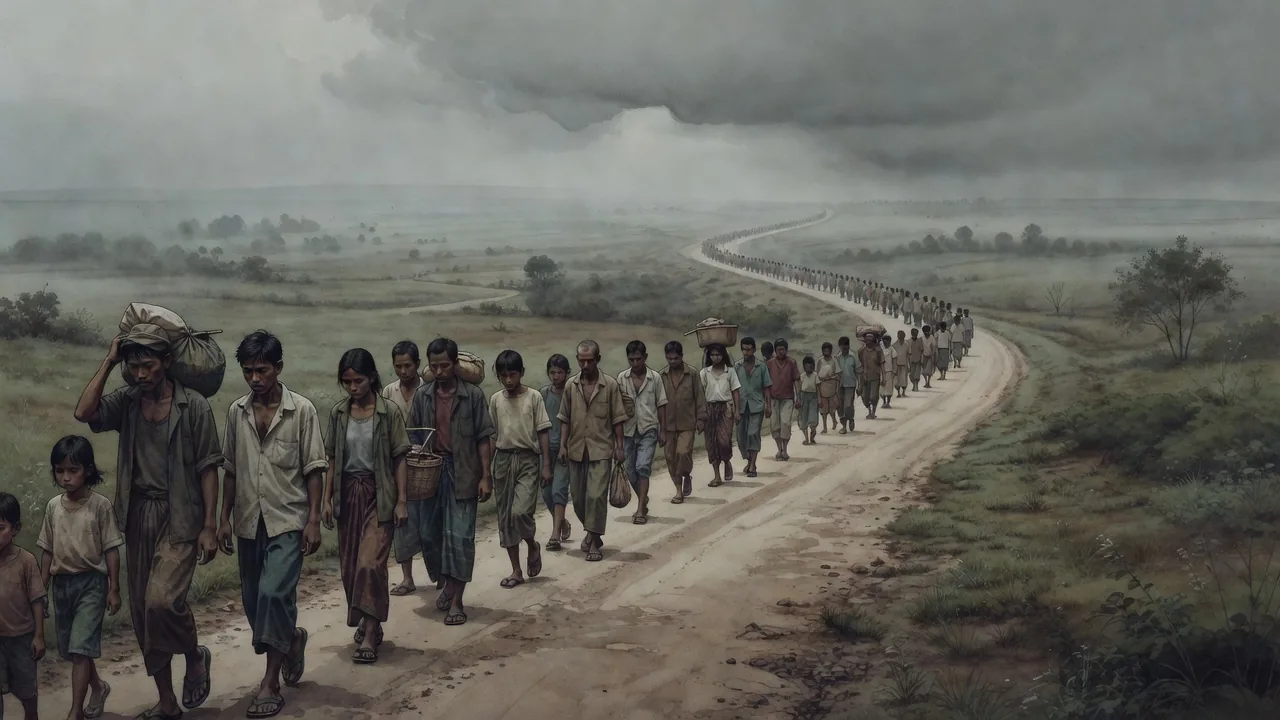
Civilians bear the heaviest burden. Airstrikes and ground fighting have forced countless residents to flee both domestically and abroad, creating a large-scale refugee and displacement crisis. The suffering of minority groups, including the Rohingya, continues unabated. While the direct security impact on Korea remains limited, the conflict merits attention for its implications for ASEAN stability, Korean companies and investments in Myanmar, and humanitarian concerns.
Outlook
In the short term, a decisive victory by either side is unlikely; “stalemate and attrition” will probably persist. The military’s election is unlikely to gain international recognition, and the resistance forces remain limited by their lack of a unified command structure. Until negotiations begin, the suffering is expected to continue.
The International Community’s Dilemma
The international community lacks clear leverage over Myanmar’s civil war. ASEAN is constrained by its principle of “non-interference in internal affairs” and differing views among member states, while Western sanctions have not significantly altered the military’s calculations. China and Russia continue to maintain relations with the military. The conditions for a “prolonged, unmanaged conflict” are in place—neither strong external intervention nor a swift negotiated settlement appears feasible.
Frequently Asked Questions
Q. Is the military’s 2026 election legitimate?
Resistance forces and much of the international community view it as a “sham election” designed to legitimize military rule and do not recognize it. Control on the ground and legitimacy are seen as separate issues.
Q. Are the resistance forces unified?
The People’s Defense Forces and Ethnic Armed Organizations maintain loose coordination but have not merged under a single command. This fragmentation makes it harder for them to decisively defeat the military.
Personally, I believe the outcome of Myanmar’s civil war will hinge less on “battlefield victories” than on the “isolation of the military, which ultimately fails to secure international legitimacy.” Guns may hold territory, but they cannot confer legitimacy.