An intel-feed roundup of two fronts. Today’s focus isn’t a mere snapshot but “what has changed.” Reading OSINT, I always watch two things at once—what happened, and who, from which camp, released the information. Below I attach confidence levels and bias notes. Reference point: July 2, 2026.
The Middle East — From ‘War’ to ‘Aftermath’
The biggest change first. Until this spring, the Middle East’s center was the hot war between the U.S.-Israel and Iran. Now it has moved to that war’s aftermath. Large-scale fighting stopped after the April ceasefire, and in Iran the phrase “100 days since the U.S.-Israeli war” has appeared.
The heaviest fact that war left behind—the death of Iran’s Supreme Leader Ali Khamenei. He was killed on February 28, 2026 in a joint U.S.-Israeli airstrike (confirmed by Iran on March 1), and his son Mojtaba Khamenei was elected successor Supreme Leader on March 8. The delayed state funeral runs July 4–9, moving through Tehran, Qom and Iraq (Najaf, Karbala) to burial in Mashhad. Iranian authorities say they are preparing for up to 35 million mourners. Russia is sending Security Council deputy chair Medvedev as Putin’s envoy. (Confidence: high—cross-confirmed by multiple mainstream outlets.)
What I note here is the “number.” A funeral of 35 million is not mere mourning but a political event to sear the son’s legitimacy into domestic and foreign audiences. Iran is trying to seal the moment hereditary succession hardens with the largest possible crowd.

The second change—violence didn’t stop, it migrated. As naval clashes in the Strait of Hormuz subsided, the stage shifted to the West Bank, East Jerusalem and southern Lebanon. On July 1–2 Israeli forces ran large night raids across multiple cities—Nablus, Ramallah, Hebron—and reports said Minister Ben-Gvir personally oversaw demolitions of Palestinian homes in East Jerusalem (pro-Palestinian channel QudsNen; specific on scale/time/place but no Israeli official confirmation collected—confidence medium-high). In southern Lebanon, despite the June 26 Israel-Lebanon framework agreement, Israeli drone, artillery and demolition operations are actually expanding (pro-Hezbollah Al Mayadeen—confidence medium).
Third—diplomacy is diverging. On July 1 the U.S. and Israel signed an agreement on land for a new U.S. Embassy compound in Jerusalem, hardening their embrace further. Meanwhile in the U.S. House, Rep. Massie filed an amendment to block $3.3 billion in annual military aid to Israel (I rate passage unlikely). U.S.-Iran contact in Doha was rumored, but Iranian Deputy FM Gharibabadi denied “any direct meeting.” The big picture—the U.S.-Israel alliance deepens, while U.S.-Iran dialogue is a blinking traffic light.
Russia-Ukraine — Two New Variables Amid Attrition
The big picture here is still attrition. Ukraine itself admitted losing 84 km² of territory in June (since pro-Ukraine DeepStateUA conceded the loss, confidence is high), and Russia claims small-village captures at Kopani in eastern Zaporizhia and toward Burluk in the northeast. But all are small; there is no strategic breakthrough. In the early hours of July 2, Russia hit Kyiv with a concentrated missile-and-drone strike, and a fire broke out at the downtown Premier Palace Hotel.
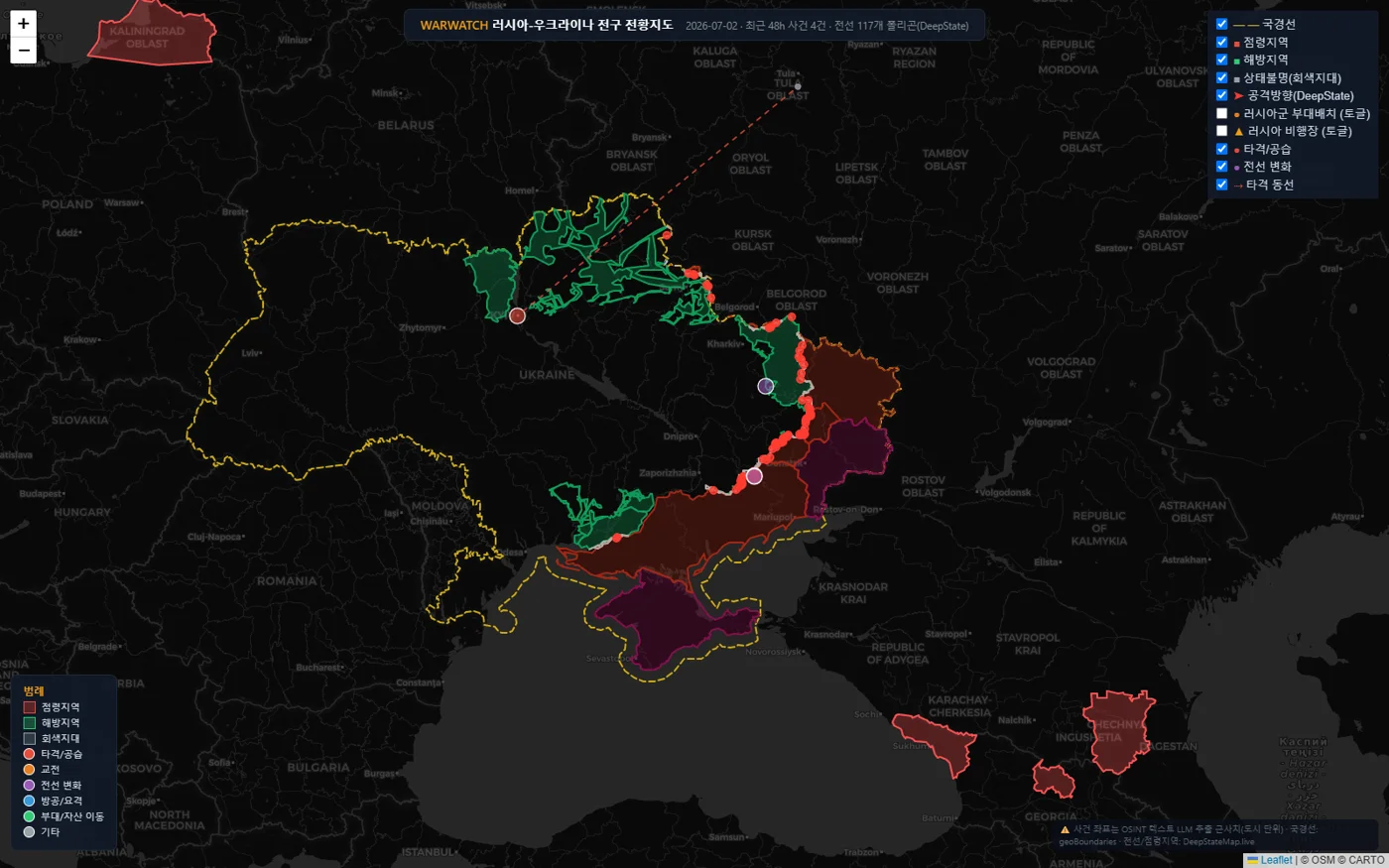
Onto this were bolted two new variables. First, a two-way escalation of the energy/fuel-infrastructure war. Russia launched a campaign hitting 7+ gas stations and oil depots across Ukraine (a one-sided claim by pro-Russia Rybar, but a logical target given Ukraine’s reliance on imported fuel). In return, Ukraine struck the Vtorovo oil pumping station in Russia’s Vladimir region (which supplies Moscow) by drone. With the front line deadlocked, both sides have begun targeting each other’s “fuel arteries.”
Second, Ukraine’s future air-force card. On June 30 Ukraine signed a deal to buy 16 new Gripen E fighters from Sweden ($2.5B). But delivery is 2029–2030—not near-term combat power (the existing 16 Gripen C/D are to transfer in early 2027). Add the EU’s June 30 transfer of €3.9 billion to Ukraine for 2.8 million domestically made drones. In short, “far-future fighters” and “here-and-now drones” roll forward at once. Russian channels mention an “Anchorage meeting,” hinting a negotiation channel exists.
What Runs Through Both Fronts — My Analysis
They are separate wars, but I see the same grammar. Both have moved from “ending” to “managing.” The Middle East has settled into a management phase of occupation, succession and low-intensity clashes; Russia-Ukraine into a management phase of long attrition after giving up on big breakthroughs. Not victory or defeat, but continuation, has become the new normal.
And across both fronts the formula “energy is a weapon” recurs. In the Middle East earlier through Hormuz and oil; in Russia-Ukraine now through gas stations and pipelines. When army-on-army clashes deadlock, war always spreads to the opponent’s economic arteries—especially fuel. There’s also a shared time-axis tension: “far-future advanced weapons (Gripen) vs. here-and-now expendables (drones).” The board-changing weapon arrives years later, while today’s war is fought with cheap consumables.
Finally, the cross-verification principle again. Much of this Middle East intel came from pro-Palestinian and pro-Hezbollah channels, with Israeli official confirmation rare (an information gap). Russia-Ukraine intel is inflated by pro-Russia Rybar and pro-Ukraine DeepStateUA each for their own side. So I weight more heavily what both sides acknowledge (Khamenei’s funeral; Ukraine’s 84 km² loss) or what a side admits against its own interest (Ukraine’s self-disclosed territorial loss). The rest I read only as direction, without asserting.
Watch Points (Next 1–2 Weeks)
- Khamenei funeral (Jul 4–9): up to 35 million—a legitimacy event for the Mojtaba hereditary line. Watch crowd size and any flashpoints.
- Southern Lebanon: Israeli operations expanding despite the framework deal → watch for a Hezbollah retaliation scenario.
- U.S. House vote: the $3.3B Israel-aid block—less about passage than the vote margin as a signal on U.S.-Israel ties.
- RU-UA energy war: how far the mutual fuel-infrastructure strikes expand—impact on Ukraine’s power/fuel grid before winter.
- Negotiation channel: whether the “Anchorage meeting” is real—watch for a restart of RU-UA diplomacy.
Frequently Asked Questions (FAQ)
Yes. Iran’s Supreme Leader Ali Khamenei was killed on February 28, 2026 in a joint U.S.-Israeli airstrike, and the Iranian government confirmed it on March 1. His son Mojtaba Khamenei was elected successor Supreme Leader on March 8, and the delayed state funeral runs July 4–9 through Iran and Iraq. It is cross-confirmed by multiple mainstream outlets.
The stage moved. As the U.S.-Israel-Iran hot war and Hormuz naval clashes subsided, the center of violence shifted to the West Bank, East Jerusalem and southern Lebanon. At the same time, “post-war” politics and diplomacy—Khamenei’s funeral (succession) and the Jerusalem U.S. Embassy land deal—came to the fore.
Two. (1) A two-way escalation of the energy/fuel-infrastructure war—Russia hitting Ukrainian gas stations and oil depots, Ukraine striking a Russian oil pumping station by drone. (2) Ukraine’s purchase of 16 Gripen E jets (delivery 2029–30) and the EU’s mass drone funding. The ground war remains attritional; Ukraine admitted an 84 km² loss in June.
Read it by source bias. Much Middle East intel comes from pro-Palestinian and pro-Hezbollah channels with rare Israeli confirmation. Russia-Ukraine intel is inflated by pro-Russia and pro-Ukraine channels alike. This piece weights facts both sides acknowledge, or that a side admits against its own interest (Khamenei’s funeral, Ukraine’s territorial loss), and presents the rest only as direction.