Fifteen years in the army left me with one habit. Each morning I lay out the situation map first, sort “what in yesterday’s reports is fact and what is one side’s claim,” and only then begin to judge. Today (June 20, 2026) I read the two fronts — Russia-Ukraine and the Middle East — by that habit. The bottom line: both are a mesh of “attrition without a decisive result” and “paper-thin diplomacy.” Below is a field brief I sorted by confidence, cross-checking pro-Russian, pro-Ukrainian, pro-Israeli, pro-Palestinian, pro-resistance, and neutral channels.
– Ukraine: mass use of low-cost drones plus strikes on Russia’s rear — signals of entering a summer-offensive phase
– Middle East: the Lebanon ceasefire “resumed” on June 19 but both sides violated it immediately — effectively a pause, not peace
– US-Iran nuclear talks are live in Switzerland (Witkoff, Kushner, Qatar’s PM) — a 60-day window
– Read by “verified / one-sided claim / unverified” to avoid being swept up by propaganda
– For Korea it connects through oil (a softer Brent), defense demand, and US strategic-resource allocation
Front 1: Ukraine — Drones Open the Summer
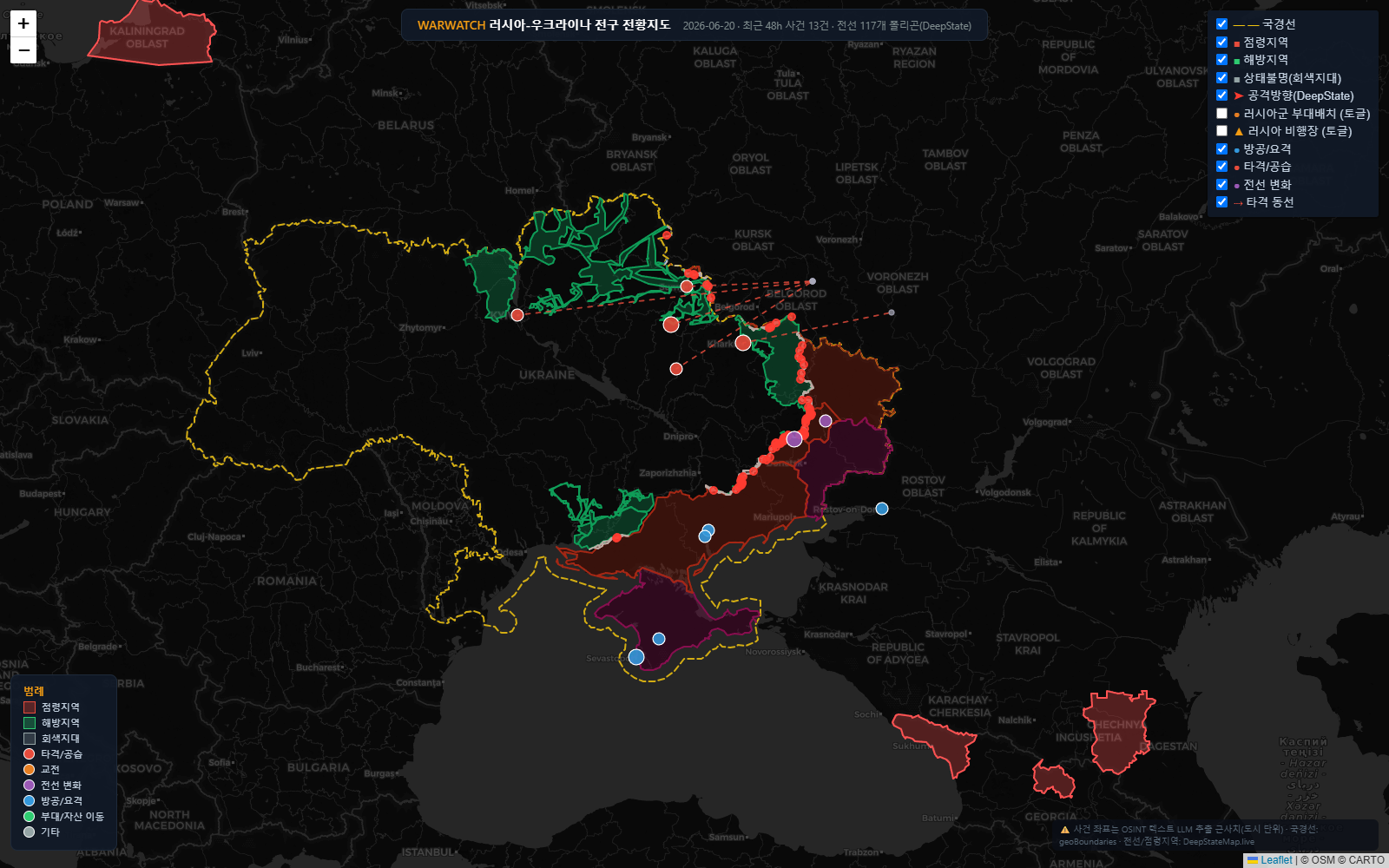
The picture relayed by the pro-Russian channel Rybar is that “Ukraine has begun mass-operating drones, even pulling in weather balloons and cheap UAVs.” The same channel also claimed Zelensky issued “practically unlimited UAV authorization” — but that part has murky sourcing and a speculative tone, so I file it as a “one-sided claim.” Conversely, there are things both sides’ channels acknowledge: that drone-operation intensity has risen and a mutual rear-strike campaign is underway. Nighttime air-defense activity toward Rostov, Crimea, Sevastopol, and Zaporizhzhia, and a dawn cruise-missile fire in Kharkiv, are facets of it.
As a former soldier, what I watch here is not the “numbers” but the “attrition rate.” Shaking the rear with low-cost drones may not produce a flashy breakthrough, but it rapidly burns the other side’s air-defense missiles and interceptors. Rybar’s claim that “Ukraine’s refineries are already mostly destroyed, so symmetrical retaliation is hard” — with no opposing report, I judge a high chance of exaggeration. Still, the subtext reads that this war’s contest has shifted from meters at the front to who can sustain rear industry, energy, and supply longer. Whether the summer offensive has truly begun will be told by movements toward Kharkiv and Zaporizhzhia over the next 24-48 hours.
Front 2: Lebanon — The Contradiction of a “Resumed Ceasefire”
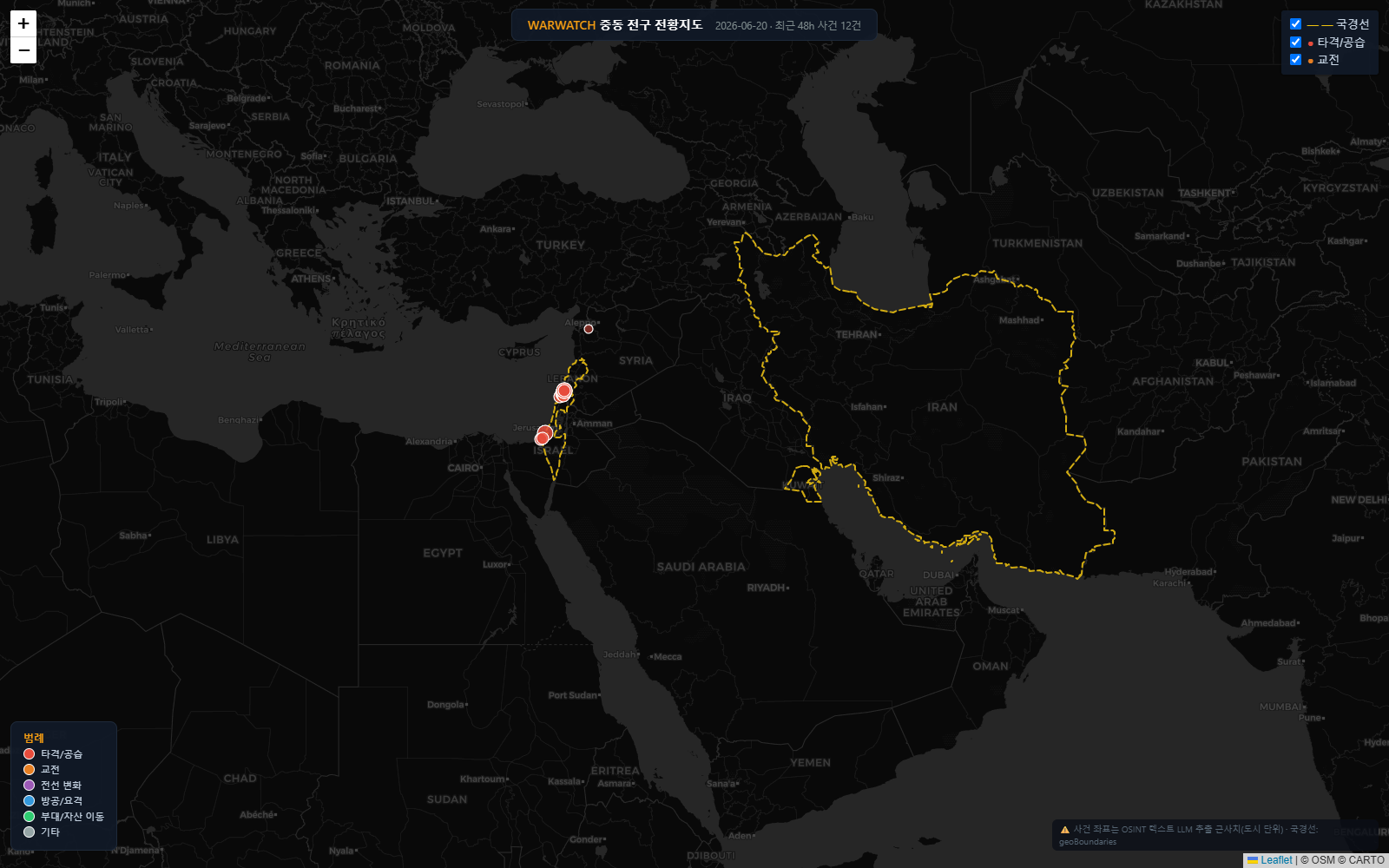
The Middle East is stranger. From 4 p.m. Israeli time on June 19, a US-Qatar-brokered Israel-Hezbollah ceasefire “resumed.” This is a high-confidence fact confirmed by the IDF, US officials, and neutral monitors (warmonitors). And yet — that both sides resumed attacks right after the ceasefire deal is also confirmed by multiple sources. The IDF announced it struck about 150 Hezbollah targets after midnight; Hezbollah, with an explosive drone, killed an IDF tank-battalion commander, Lt. Col. Dor Gedalia Ben Simhon (32), along with three others. Lebanon’s Health Ministry tallied 18 killed and 40 wounded in the south.
Here is the sentence that catches a soldier’s eye first. The IDF spokesman said it retains “full freedom of action against any threat in southern Lebanon.” A “ceasefire that reserves freedom of action” is itself a contradiction. To a field commander that reads not as “do not fire” but as “fire if you have a pretext.” So I see this ceasefire not as an “agreement” but as a “pause.” It is peace on a single sheet of paper, a structure where one misjudgment by either side reignites it. In Gaza, too, civilian casualties keep coming, including a four-year-old in an airstrike on a residence on Al-Thalathini Street.
In frontline reporting, the first thing I look at is “who said it.” When one channel reports and the other stays silent, it is a claim, not a fact. Battlefield results and casualty figures that are not cross-confirmed I always read at a discount — it is the first principle an intelligence staff officer learns in the army.
Meanwhile, in Switzerland — US-Iran Talks
Beyond the smoke of the two fronts, the card that will actually decide the board is moving in Switzerland. White House envoy Steve Witkoff and Jared Kushner headed there, and Qatar’s prime minister arrived. It is the follow-up to the memorandum of understanding (MoU) the US and Iran finalized earlier — the 60-day nuclear negotiation now getting underway. Trump told NBC he “asked Israel to agree to the Lebanon ceasefire,” yet inside Israel former PM Naftali Bennett publicly criticized Netanyahu’s “protracted war” strategy, and one poll found 71% do not trust Trump to look out for Israel’s interests. Israel’s internal rift is itself another variable for this ceasefire.
One more thing. Israel’s Diaspora Affairs Minister Amichai Chikli said on the radio that Israel “will wage war against Syria sooner or later.” Whether this is a signal of a concrete plan or a hardliner’s bluster needs more watching. But that such remarks come out in the middle of ceasefire talks shows just how thin the ice under this region’s “pause” really is.
The Staff Officer’s Synthesis — The Bill These Fronts Send Korea
Overlay the two fronts and a common structure appears. Militarily, attrition where neither side holds a decisive edge; diplomatically, temporary deals that can break at any time. And the US is wedged into both as mediator, its attention and resources dispersed. In my view, that “dispersion” is the key variable for the coming months. The more the US reaches into the Middle East, Ukraine, and the Indo-Pacific at once, the more pressure it puts on allies to share the load. The Korean Peninsula sits within that field too.
The economic bill is clear as well. With the Iran blockade lifted, Brent has already fallen, which is favorable for Korea’s prices and trade balance as a crude importer. At the same time, prolonged fighting on both fronts stokes defense demand and supply-chain realignment. Reading the war, in the end, is not about consuming military news but tracking how that gunfire spreads into oil, FX, and industry. That is why I always try to judge only on facts both sides acknowledge, not one channel’s propaganda. The broader context continues in my earlier Iran MoU & Middle East Outlook and at Chief Briefing.
Frequently Asked Questions (FAQ)
The “resumption” is a high-confidence fact brokered by the US and Qatar on June 19, but the IDF agreed while reserving “full freedom of action,” and both sides resumed attacks immediately. A “ceasefire that leaves freedom of action” is structurally contradictory, so it is closer to a “pause” than an agreement.
It is attrition with no decisive edge for either side. But rising Ukrainian low-cost drone operations and strikes on Russia’s rear signal a “summer offensive” phase. Both sides commonly acknowledge higher drone intensity and mutual rear strikes; claims like the scale of refinery destruction are one-sided and need verification.
It cross-checks pro-Russian (Rybar) and pro-Ukrainian, pro-Israeli (IDF), pro-Palestinian (QudsNen), pro-resistance (Al Mayadeen), and neutral OSINT (warmonitors, clashreport). Only items both sides acknowledge are marked “high confidence”; one-sided reports are filed as “claims” and discounted.
With the Iran blockade lifted, Brent is softer, which is favorable for Korea’s prices and trade balance. At the same time, prolonged fighting on both fronts affects the Korean Peninsula’s security environment indirectly through defense demand, supply-chain realignment, and US strategic-resource allocation across the Middle East, Europe, and the Indo-Pacific.
📚 References
- OSINT Telegram cross-check: Rybar (Pro-RU), IDF/manniefabian (Israel), QudsNen (pro-Palestinian), Al Mayadeen (pro-resistance), warmonitors/clashreport (neutral)
- War maps: drawn in-house on open sources including DeepState-type data
- Lebanon Health Ministry casualty tally / Reuters and NBC reporting
- Chief Briefing, Iran MoU & Middle East Outlook / Russia-Ukraine War OSINT (2026)