Enhancement Doctrine AI coexistence — is this framework sustainable?
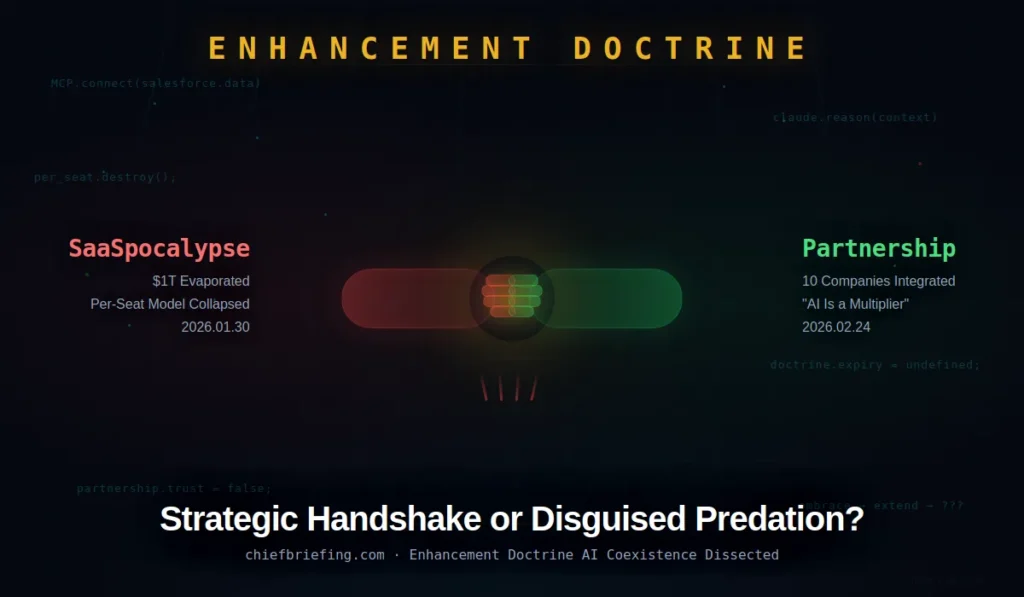
The Enhancement Doctrine AI coexistence narrative drove a software sector rebound on February 24–25. When Anthropic announced Claude Cowork integration partnerships with 10 companies including Salesforce, DocuSign, Intuit, LegalZoom, FactSet, and Gmail, the strongest buying wave since SaaSpocalypse surged in. Salesforce +4%, Thomson Reuters +11%, FactSet +6.2%, DocuSign +5.8%.
Wedbush Securities assessed that “AI will not rip and replace existing software ecosystems, and the selloff was overblown” (CNBC). The market’s interpretation was straightforward: “AI is not a predator of software but a multiplier.” This is the so-called “Enhancement Doctrine”.
However, from a strategic analysis perspective, the Enhancement Doctrine AI coexistence narrative contains at least three layers of doubt. This article dissects the structural sustainability of this doctrine through three lenses: timeline, actor diversity, and historical precedents of platform absorption.
Timeline Analysis: Strike First, Then Shake Hands on Favorable Terms
What the Sequence of Events Reveals
Reading the Enhancement Doctrine AI coexistence announcement timeline in reverse reveals a different picture.
| Date | Event | Impact |
|---|---|---|
| Jan 30 | Claude Cowork 11 plugins open-sourced | SaaS sector $1T evaporated, per-seat model trust collapsed |
| Feb 3–5 | 3-stage mechanical selloff cascade (algo → ETF → short sellers) | Salesforce -22%, Intuit -33%, Thomson Reuters -31% |
| Feb 20 | Claude Code Security announced | Cybersecurity sector additional decline (CrowdStrike -7.2%, Zscaler -7.1%) |
| Feb 24 | Enhancement Doctrine partnership announced | Same companies sharply rebound |
Read strategically, this is the classic pattern of “create crisis → secure favorable terms → seal partnership.” The January 30 offensive drove SaaS companies’ stock prices and bargaining power to rock bottom, and the February 24 partnership materialized under those conditions. This is not an equal collaboration — it is integration under asymmetric bargaining power.
The Actual Structure of the Partnership
Anthropic’s MCP (Model Context Protocol) is a protocol through which Claude directly accesses partner companies’ data. The direction of the value chain in this structure is clear:
- What Anthropic gains: Access to Salesforce’s CRM data, DocuSign’s contract archives, FactSet’s financial data, and Intuit’s tax data
- What SaaS companies gain: Claude’s reasoning capabilities embedded in their platforms for “AI-native” positioning, stock price recovery
In the short term, both sides benefit. But in the medium to long term, between the party that secures data access and the party that borrows reasoning capabilities, who ends up in a stronger position? The history of technology platforms provides a consistent answer.
Enhancement Doctrine AI Coexistence: Historical Precedents of Platform Absorption
To evaluate the Enhancement Doctrine AI coexistence narrative, we must examine what actually happened after similar “coexistence declarations.”
Amazon Marketplace → Amazon Basics (2007–Present)
Amazon told marketplace sellers “let’s grow together.” After analyzing sellers’ sales data, it launched its own private-label brand (Amazon Basics) in the most profitable categories. The 2020 U.S. House Antitrust Subcommittee report classified this as a “structural conflict of interest.”
Structural parallel: Anthropic, after learning partner companies’ workflow data through MCP, positions itself to offer identical functionality through Claude’s own plugins.
Google Maps + Yelp (2005–2014)
Google displayed Yelp’s review data in search results, calling it “coexistence for users.” After enriching Google Maps with Yelp’s data, it strengthened its own review system and absorbed Yelp’s traffic. Yelp’s CEO testified before the U.S. Senate in 2011, describing it as a “parasitic relationship.”
Structural parallel: Once Claude learns the context of DocuSign’s contract data, it could offer “contract analysis” as a standalone service, eroding DocuSign’s core value proposition.
Microsoft “Embrace, Extend, Extinguish” (1990s)
Microsoft’s 1990s strategy can be summarized in three stages: ①Embrace competing technology, ②Extend by integrating it into its own ecosystem, then ③Extinguish the original. Netscape, Java, and countless competing technologies exited the market through this pattern.
Structural parallel: Enhancement Doctrine is currently at the “Embrace” stage. MCP integration represents the “Extend” stage. The question is whether “Extinguish” follows.
What the Precedents Suggest
In all three cases, “coexistence” and “mutual benefit” were real in the initial phase. However, once data and user habits concentrated around the platform leader, coexistence transitioned into dependency. For the Enhancement Doctrine AI coexistence narrative to be an exception to this pattern, Anthropic would need structural mechanisms that deliberately limit its own interests. Currently, no such mechanisms are visible.
▶ Related Analysis: SaaSpocalypse — AI-Triggered 3-Stage Cascade Selloff
Actor Diversity: A Structure Dependent on a Single Company’s Goodwill
The most fundamental vulnerability of the Enhancement Doctrine AI coexistence framework is its dependence on the strategic choices of a single actor — Anthropic.
Multiple Threats Already Exist
| Actor | Status | Enhancement Doctrine Compliance |
|---|---|---|
| Anthropic | Partnership announced, coexistence declared | ○ (currently) |
| OpenAI | Frontier platform launched (Feb 5) | Unknown — pursuing independent strategy |
| Building Gemini agent ecosystem | Unknown — prioritizing internal Workspace integration | |
| Future LLMs | Not yet emerged | No obligation to coexist — can pursue direct replacement |
Even if Anthropic maintains the Enhancement Doctrine, OpenAI Frontier could adopt a strategy of directly replacing the same SaaS market. More critically, future LLM companies that have yet to emerge carry no legacy partnerships with existing SaaS firms and have no incentive to show the same “courtesy” as the Enhancement Doctrine.
The Exclusivity Problem
Looking at the current Enhancement Doctrine structure, Anthropic can partner with Salesforce while simultaneously opening the same MCP access to Salesforce’s competitors (HubSpot, Zoho, etc.). Moreover, there is no binding commitment anywhere preventing Anthropic from building CRM functionality directly into Claude tomorrow.
This means the Enhancement Doctrine AI coexistence narrative is based on strategic convenience, not legal obligation. Strategic convenience changes when circumstances change.
The Indefensible Scenario
The most dangerous scenario is compound: even if Anthropic maintains the Enhancement Doctrine, if OpenAI pursues a direct replacement strategy and simultaneously a new LLM enters the market more aggressively, existing SaaS companies cannot escape competitive pressure even under Anthropic’s protection. The Enhancement Doctrine only governs the relationship with Anthropic — it does not determine the direction of the entire LLM industry.
Counterarguments and Balance: Conditions Under Which Enhancement Doctrine AI Coexistence Could Persist
For fair analysis, we must also examine scenarios where the Enhancement Doctrine AI coexistence narrative could actually hold.
Coexistence Enforced by Regulation
The EU AI Act and U.S. AI regulation discussions are underway. If legislation passes prohibiting LLM companies from using partner data to build competing services, the Enhancement Doctrine becomes a legal obligation rather than a voluntary choice. In that case, coexistence could be structurally sustained.
Underestimating Enterprise Inertia
The cost of software transitions for large enterprises extends beyond technical costs. Organizational culture, employee training, compliance, and audit trails — non-technical costs — suppress transitions. Replacing Salesforce’s CRM with Claude’s native functionality may be technically possible but could take 5–10 years in practice.
AI Companies’ Own Strategic Calculus
Anthropic’s business model is API billing and enterprise subscriptions. Directly entering the SaaS market would require operating thousands of industry-specific customized solutions — far removed from Anthropic’s core competency (model development). Collecting partnership fees may simply be a more efficient business.
Strategic Judgment Matrix
Organizing the variables surrounding the Enhancement Doctrine AI coexistence narrative along time and actor axes yields the following framework.
| Time Frame | Anthropic Alone | Multiple LLM Competition | With Regulatory Intervention |
|---|---|---|---|
| 6 months – 1 year | Coexistence maintained, real partnership synergy | OpenAI Frontier impact limited | Regulatory discussion stage |
| 1 – 3 years | Data learning accumulates, independent capability grows | New LLMs begin direct replacement attempts | Partial regulation possible |
| 3 – 5 years | Embrace → Extend transition possible | Simultaneous multi-LLM pressure on SaaS | Only strong regulation guarantees coexistence |
Enhancement Doctrine AI Coexistence — A Doctrine Is Strategy, Not a Promise
Enhancement Doctrine AI coexistence — at this point, it is a rational strategic choice by Anthropic. The market’s rebound is not irrational in itself. In the short term, the partnership delivers value to both sides.
But do not be deceived by the word “Doctrine.” A doctrine is not law. When the strategic environment shifts, doctrines shift with it. The reason America’s Monroe Doctrine has remained effective for 200 years since its declaration is the overwhelming military power that underwrites it. There is currently no structural enforcement mechanism underwriting the Enhancement Doctrine.
Considering the historical precedents of platform absorption, the existence of multiple LLM actors, and the absence of legal binding force, the Enhancement Doctrine AI coexistence narrative is a time-limited strategic equilibrium. Determining when this equilibrium breaks will be the central challenge of tech sector analysis for the next two to three years.
Related Analysis : Enhancement Doctrine SaaS Rebound: Should You Trust Anthropic’s Handshake?
Frequently Asked Questions (FAQ)
In the short term, it clearly does. Embedding Claude’s reasoning into existing software enables “AI-native” positioning and justifies premium pricing. The question is the medium-to-long-term dynamic — what happens after AI has sufficiently learned these companies’ data and workflows.
Watch for three triggers. First, the moment Anthropic or a competing LLM launches a partner company’s core functionality as a standalone service. Second, the moment a new LLM delivers end-to-end workflows without existing SaaS. Third, the moment partner companies’ quarterly earnings show ARPU declining after AI integration.
Amazon Marketplace → Amazon Basics, Google Maps and Yelp, and Microsoft’s Embrace-Extend-Extinguish strategy are structurally analogous. All three began with coexistence and, after data accumulation, reorganized around the platform leader.
Institutional investors can leverage the Enhancement Doctrine’s short-term effects within 6–12 month earnings cycles. Retail investors, with typically longer time horizons, are safer constructing portfolios around companies with clear data moats and high switching costs.