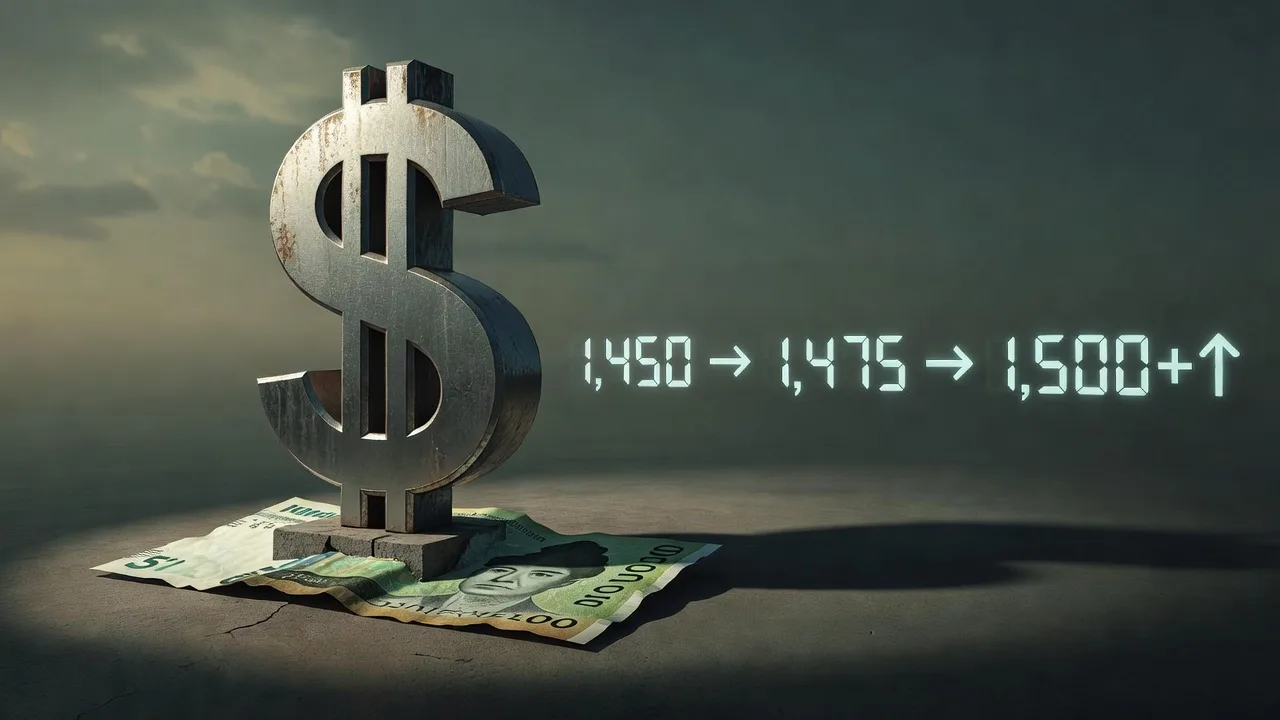
dollar investing, is it okay to enter now. With the won-dollar exchange rate hovering above 1,500, many people are asking the same question. It feels too high to commit, yet the fear it could climb further creates unease. To find an answer, we first need to unpack why the dollar has grown so strong and how long that strength might last. In June 2026, the dollar index (DXY) pushed back above 100, driven by robust U.S. employment, sticky inflation, and safe-haven demand sparked by geopolitical tensions. The shadow of that strong dollar falls squarely across the Korean economic outlook.
- The dollar index (DXY) broke above 100 on June 8, reaching its highest level since April and posting roughly 1% monthly gains.
- Three forces underpin the strong dollar: May employment that far exceeded forecasts (+172k), sticky inflation (CPI at 4.2%), and safe-haven flows tied to Middle East developments.
- The won-dollar rate is centered in the 1,500 range, with some forecasts pointing to a possible move toward 1,600 in July.
- Most projections place the 2026 DXY in the 93–100 band, though any sustained dollar weakening hinges on the Fed gaining room to cut rates.
- Korea’s economy is expected to strengthen in the first half before slowing in the second, with exports heavily concentrated in semiconductors and domestic demand recovering only gradually. Concerns over a “high-exchange-rate new normal” are rising.
- dollar investing vehicles include dollar deposits, dollar ETFs, U.S. stocks and bonds, and foreign-currency products, each carrying different tax and currency-conversion costs.
dollar investing — Why the Strong Dollar Persists
Any assessment of dollar investing must begin with the roots of dollar strength. On June 8, 2026, the dollar index climbed to 100.07, its highest reading since early April and roughly 1% higher over the past month. This advance is not random; three forces are operating in tandem.
Employment and Interest Rates Provide Support
The first driver is interest-rate expectations. May U.S. employment rose by 172,000, more than double the consensus forecast of 85,000. With the labor market refusing to cool, markets pushed back expected Fed rate cuts and began pricing in the possibility of further tightening. Higher-for-longer rates attract capital to the currency that offers those yields. The reasons behind the Fed’s constrained position are examined in detail in FOMC Rate Outlook — Warsh’s First Meeting and CPI at 4.2%.
Inflation and Safe-Haven Demand
The second factor is sticky inflation. May CPI printed at 4.2% year-on-year, the highest in more than three years, reinforcing the view that rate cuts remain distant. The third element is safe-haven demand. Prolonged U.S.–Iran tensions and Hormuz Strait concerns have kept oil prices elevated, channeling risk-averse flows into the dollar as the world’s reserve currency. Interestingly, gold—the other classic safe haven—has been pressured by the same dollar strength; that paradox is explored in Gold Price Outlook — Why Gold Fell Despite War. In short, today’s dollar strength rests on three legs: rates, inflation, and geopolitics.
dollar investing: How Long Will the Strong Dollar Last?
How far can this strength extend? Most forecasts see the dollar index trading between 93 and 100 for the remainder of 2026. While the consensus points to eventual dollar softening, that outlook carries a clear precondition: the Fed must first regain room to cut rates. Until oil-driven inflation subsides and the Fed pivots to easing, the structural drivers of dollar strength are unlikely to dissipate quickly.
Historically, strong-dollar episodes have never lasted indefinitely. The pattern has been consistent: the dollar surges as a safe haven during crises, then retreats once the Fed begins easing. Markets summarize this dynamic as the “dollar smile”—the currency strengthens when the U.S. economy is either exceptionally robust (high rates) or under acute stress (safe-haven flows), and weakens during the benign recovery phase in between. At present, both “strong” and “stressed” conditions overlap, supporting the dollar from two sides. Any reversal will likely require one of those supports to give way—either a noticeable cooling in U.S. growth or a material easing of geopolitical tensions.
Keys that unlock — stable oil prices, cooling U.S. inflation, a Fed pivot to cuts, de-escalation in the Middle East. Locks that tighten — resilient U.S. employment, sticky inflation, persistent geopolitical risk, the Korea–U.S. rate differential. At the moment, the “locks” dominate. The market’s key inflection point remains the timing of the Fed’s first rate cut.
For a more layered view of exchange-rate direction, Atomic Economy Blog’s 2026 Won–Dollar Exchange Rate Outlook — Rise, Fall, or Stabilization and Won–Dollar Exchange Rate Self-Diagnosis Guide offer useful context.

dollar investing and the Korean Economic Outlook — The Bill Left by a Strong Dollar
A strong dollar cuts straight through the heart of Korea’s economic outlook. The 2026 Korean economy is projected to follow a “first-half strengthening, second-half slowdown” trajectory. Consumption-led domestic demand and fiscal expansion provide a floor, yet the quality of growth remains uneven. Exports are propelled by AI and semiconductor demand, but the benefits are concentrated in a narrow set of sectors, while household spending power improves only slowly. One engine—semiconductors—is effectively pulling the entire economy.
The Semiconductor Illusion and the “High-Exchange-Rate New Normal”
The exchange rate is the core issue. While the Fed keeps rates elevated, the Bank of Korea’s policy rate sits at 2.50%, widening the interest-rate gap and weighing on the won. Structural low growth and household debt add further pressure, making won weakness difficult to reverse. The rate has already pierced 1,540, and market chatter about a 1,400-level “new normal” is growing louder. A weaker won lifts import prices and passes the burden directly to household budgets. Everyday implications are examined in Ilconomy Blog’s Hormuz Double Blockade: What Happens to Prices, Exchange Rates, and Interest Rates?.
Korean authorities are not idle. Verbal intervention and fine-tuning have repeatedly slowed the pace of won depreciation. Yet reversing the broader trend is far harder, and foreign-reserve ammunition is finite. The deeper problem is structural: low growth, rapid aging, and high household debt erode the won’s fundamental resilience. Even when semiconductor exports boom, the warmth rarely spreads evenly to domestic demand and households, leaving a persistent asymmetry—solid headline indicators alongside a weak currency. This is why the phrase “high-exchange-rate new normal” keeps surfacing in discussions of the Korean economic outlook. The exchange rate is increasingly reflecting structural vulnerabilities rather than cyclical conditions.
Here dollar investing reveals its second face. Households burdened by a weak won can offset some of that pressure by holding a portion of assets in dollars; any further rise in the exchange rate translates into valuation gains. Thus dollar investing functions simultaneously as a return-seeking strategy and as a hedge against won depreciation and rising import costs. At the same time, entering at already elevated levels carries the clear risk of currency losses should the won rebound later.
dollar investing Methods — A Comparison of Four Routes
How, then, should investors gain dollar exposure? Four primary channels exist in Korea, each with distinct tax treatment, conversion costs, and accessibility.
| Method | Characteristics | Tax & Costs | Suitable For |
|---|---|---|---|
| Dollar deposits (foreign-currency accounts) | Convert won to dollars and deposit; covered by deposit insurance | Individual FX gains tax-free; spread on conversion; low interest | Safety and short-term holding |
| Dollar ETFs | Track dollar or U.S. Treasury indices; traded via brokerage accounts | Domestic ETFs: 15.4% dividend withholding on gains; management fees | Convenience and diversification |
| U.S. stocks & bonds | Direct ownership of dollar assets (growth + currency exposure) | 22% capital-gains tax on overseas stocks (after 2.5 million won annual deduction); includes FX gains | Active, long-term investors |
| Foreign-currency RP, dollar insurance, etc. | Short-term or protection-oriented products | Varies by product; early-termination losses possible | Goal-specific needs |
Beginners often find dollar deposits or dollar ETFs the most accessible because conversion friction is low and small, regular purchases are straightforward. The key discipline is dollar-cost averaging rather than lump-sum entry. At already elevated exchange rates, spreading purchases helps manage the risk of subsequent currency losses. Tax-efficient account strategies are discussed in ISA Accounts: Up to 2 Million Won Tax-Free.
dollar investing Scenarios — Three Possible Paths
Three broad scenarios frame the outlook for dollar strength.
A. Persistent strength (probability: medium-high)
Oil prices and inflation remain elevated and the Fed delays cuts. The exchange rate settles around 1,500, preserving the appeal of dollar-asset gains, though entry at high levels remains a concern.
B. Gradual weakening (probability: medium)
Oil prices stabilize in the second half and the Fed shifts to easing; the dollar slowly loses momentum. The rate could drift toward the low 1,400s, raising the risk of currency losses for late entrants.
C. Sharp volatility spike (probability: medium-low, tail risk)
Renewed Middle East conflict or financial shocks trigger large, rapid swings in the exchange rate. Amplitude, rather than direction, becomes the dominant risk.
In summary, current dollar investing carries two faces at once: the pursuit of gains from a strong dollar and insurance against further won weakness. Yet at levels already above 1,500, managing the pace of entry matters as much as getting the direction right. The exchange rate ultimately hinges on the timing of Fed cuts and the structural health of the Korean economy—two variables that have yet to reveal their answers.
This article provides information on exchange-rate and macroeconomic trends and does not constitute investment advice recommending the purchase or sale of any specific product. Exchange-rate, interest-rate, and tax figures reflect conditions at the time of writing and are subject to change. Foreign-exchange and overseas-asset investments carry the risk of principal loss due to currency fluctuations. Investment decisions and responsibility rest solely with the individual.
Related Analysis Worth Reading
The Fed’s calculus supporting dollar strength is examined in FOMC Rate Outlook and the Global & Korean Economies. Longer-term structural shifts in dollar hegemony are discussed in Atomic Economy Blog’s The Weakening Grip of the Dollar and the Rise of Gold.
📚 Reference Materials
- Trading Economics — Dollar Index (DXY)
- Vantage — DXY Breaks 100: June Outlook
- Trading Economics — Won–Dollar Exchange Rate
Frequently Asked Questions (FAQ)
It is difficult to endorse purchases at any single moment. The rate, inflation, and geopolitical supports for dollar strength could persist in the near term, yet the exchange rate has already moved above 1,500, making fresh lump-sum entries costly. Spreading purchases over time to manage average cost remains the most prudent way to limit currency-loss risk.
Most forecasts place the 2026 DXY in the 93–100 range. While the medium-term consensus anticipates eventual dollar softening, that view is conditioned on the Fed first regaining room to cut rates. Until oil-driven inflation moderates and the Fed pivots, the structural drivers of dollar strength are unlikely to fade quickly.
A weaker won raises import prices and passes the burden to household budgets while narrowing the Bank of Korea’s scope for rate cuts. Korea’s 2026 economy is expected to strengthen in the first half before slowing in the second, with exports concentrated in semiconductors and domestic demand recovering only gradually. Concerns about a 1,400-level “high-exchange-rate new normal” are mounting.
The main options are dollar deposits (foreign-currency accounts), dollar ETFs, U.S. stocks and bonds, and foreign-currency RP or dollar insurance products. Each carries different tax treatment, conversion spreads, and accessibility. Beginners typically find dollar deposits or small, regular dollar-ETF purchases the most approachable.
Tax treatment varies by vehicle. Individual gains on dollar deposits are tax-free, while gains on domestically listed dollar ETFs are subject to 15.4% dividend withholding tax. Overseas stocks incur 22% capital-gains tax (after a 2.5 million won annual deduction), including currency gains. Review the tax rules for each product and consider tax-advantaged accounts where appropriate.